Get Full Government Meeting Transcripts, Videos, & Alerts Forever!
Get email alerts on the School Boundaries topic
No spam. Unsubscribe anytime.
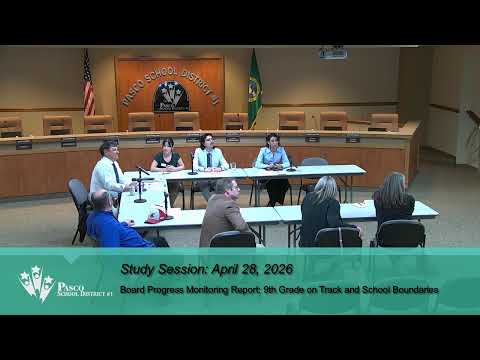
Pasco board discusses reopening attendance boundaries under Policy 3130; staff to provide capacity snapshot
Summary
Board members reviewed Policy 3130 on attendance zones and debated whether to open boundaries for reasons beyond new school openings. Members asked staff to prepare a Friday update showing percent over brick-and-mortar capacity and known operational inefficiencies to inform future decisions.
The Pasco School District board discussed whether the district should consider additional triggers to reopen attendance boundaries beyond the current practice of doing so only when a new school opens. Superintendent Whitney framed the conversation around Policy 3130, which authorizes periodic review of geographic attendance areas and directs the superintendent to develop procedures and factors to guide boundary decisions.
Whitney described the district's historical approaches to overcrowding—temporary portable classrooms and "overloading" students to partner schools (for example, moving students from a full school to a nearby partner school)—and said staff try to identify required moves early to minimize disruption. She presented illustrative trigger factors used in other districts: sustained enrollment imbalances, facility closures, programmatic shifts, significant housing- and development-driven population changes, and operational or financial inefficiencies (for instance, busing students who could walk to a nearby school).
Board members sought clarity about local hotspots. Whitney identified a housing development north of Burns currently assigned to Columbia River Elementary that could more naturally feed Franklin Elementary as the neighborhood develops; members noted Columbia River is already overcrowded. A board member raised the need for reliable projections and Whitney said demographers working with the district can estimate student yield from developments but that many sites are not yet occupied.
Views among board members varied: one member who raised the topic urged no boundary changes unless schools were "bursting at the seams" and asked staff to confirm projected enrollment from new development before acting. Others favored periodic reviews (suggestions ranged toward a two-year check-in) to avoid surprise overcrowding and give the community predictable cadence. Director Kubalik specifically recommended regular (biannual) reviews without committing to immediate changes.
The board reached consensus on an immediate, nonbinding next step: staff will produce a concise Friday update that shows percent over brick-and-mortar capacity for each school and highlights known operational inefficiencies (for example, busing patterns that could be inefficient). Staff said they could produce that quick snapshot and also noted the need to define transparent thresholds or timelines so families know what review intervals mean for potential changes.
Whitney also noted Assistant Superintendent Satal and a consultant have developed a mapping tool to pull housing-development data by school boundary; the district still needs demographer analysis to convert developments into projected student counts. The board asked staff to research past major boundary changes (examples from bond-era school openings were mentioned around 2013) and return with context when appropriate.
No formal policy change or vote was taken; the board asked staff to study the potential factors and return with recommendations and data to inform any future decision.