Get Full Government Meeting Transcripts, Videos, & Alerts Forever!
Get email alerts on the District Budget topic
No spam. Unsubscribe anytime.
Bastrop ISD CFO lays out budget scenarios, warns of unknowns from vouchers and special education funding
Summary
CFO Mark Mike White presented a budget workshop to the Bastrop ISD board outlining a no-growth revenue model, two compensation scenarios (1% and 2% of midpoint), and a menu of one-time uses of fund balance including additional officers and targeted pay adjustments; trustees asked administration for firm scenarios ahead of May/June action.
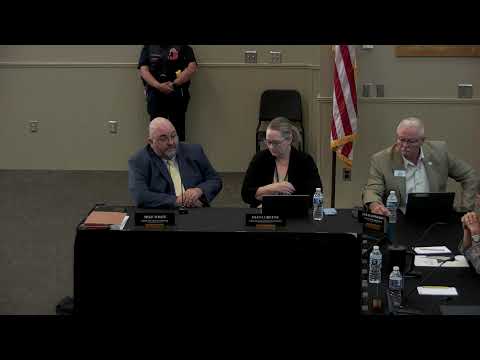
Mark Mike White, Bastrop ISD’s chief financial officer, told trustees at a budget workshop that the district is modeling next year’s revenue assuming no student growth and preparing two baseline compensation scenarios while flagging several major uncertainties affecting the budget.
White said administrators began the budget process in December and used a conservative “no growth” enrollment assumption after recent demographic work. “This wasn’t a wishlist year,” White said, describing the approach as focused on legal requirements and essential needs rather than new initiatives.
Under the base scenarios White presented, a 1% of-midpoint pay increase was the lower-cost option; an alternate 2% scenario would cost roughly an additional $1.1 million. He also offered a “menu” of possible one-time uses of fund balance: adding three school safety officers (payroll plus equipment), a $125,000 step to address mid-career teacher pay compression, and $100,000 to raise starting pay for the lowest-paid paraprofessionals.
The district’s fund balance stood at about 4.2 months (roughly $50 million), White said, and he cautioned trustees that the combination of one-time uses and any recurring raises could reduce reserves and complicate the following year’s budget. “We’re weathering the storm,” White said, pointing to recent steps to rebuild fund balance and noting the district had budgeted conservatively this cycle.
White highlighted two large sources of uncertainty: a state shift to an intensity-based special education funding model and the new Education Savings Account (voucher) program. On special education, White said the state will require districts to report under both the old placement-based model and a new intensity-based model this fall; Bastrop ISD estimates the statewide pot could translate to about $600,000 for the district but stressed that the actual amount will not be known until the state finalizes the distribution formula.
On vouchers, White reported the TEA data showed 543 applications tied to the district but only 123 of those applicants had been previously enrolled in Bastrop ISD during 2024–25. He warned that pre-K and kindergarten could be especially vulnerable: “A large number of the applications, probably the leading the pack, is pre-K and kindergarten,” White said, noting that early losses can reduce the district’s ability to capture future enrollment.
Trustees pressed staff about operational and reporting burdens. Board members asked whether the district’s special education and payroll systems, training and staffing could handle the intensity-based reporting; White and staff said the change will require significant additional data entry, potential overtime or scheduling flex, and that some technical details from the state were still pending.
The board also discussed safety funding. White said the district’s safety and security budget runs about $3.1 million; the state safety allotment covered roughly $700,000 of that. Current officer staffing was described as 21 officers; the district’s good-cause-exemption plan contemplates more officers, and White estimated adding the proposed officers and required equipment would be a multi-hundred-thousand-dollar decision that could come from fund balance if the board so directs.
Board members gave mixed initial direction: several trustees expressed support for the three menu items (officers, targeted teacher-scale adjustment, and raising starting paraprofessional pay) and debated whether to adopt a 1% or 2% midpoint raise. Some trustees favored a 2% raise to better address inflation and retention; others warned that repeated draws on fund balance could produce a spiral of cuts in later years if revenue expectations do not materialize.
White asked trustees for guidance so administration can prepare a formal recommendation for May and publish a proposed budget ahead of the June adoption process. He said accepting certain equipment purchases this fiscal year (vehicles, radios, body cameras) would require receiving those items by June 30 so they can be charged to the current budget year.
The board did not take any formal votes at the workshop. Trustees requested more detailed scenarios and historical raise data for the May meeting so they can weigh short-term support for compensation and safety against longer-term fund-balance sustainability.