Get Full Government Meeting Transcripts, Videos, & Alerts Forever!
Get email alerts on the Autism Support Summer topic
No spam. Unsubscribe anytime.
Richardson ISD trainer offers strategies to celebrate autism strengths and support summer success
Summary
Monica Knight, an in‑home parent trainer with Richardson ISD, told families at Parent University how to turn children’s special interests into leadership roles, use visual routines and sensory toolkits, and plan short, achievable outings to reduce summer regression and boost confidence.
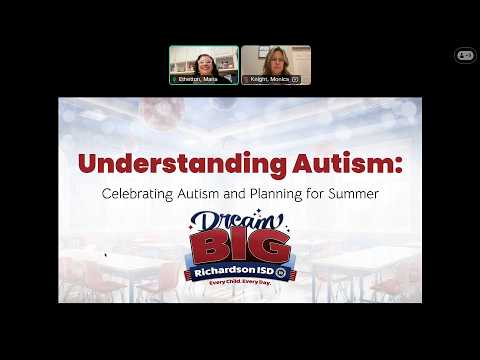
Monica Knight, an in‑home parent trainer for Richardson ISD Special Student Services, led Parent University’s final session in the district’s "Understanding Autism" series, offering practical strategies to celebrate autistic students’ strengths and sustain skills over the summer.
Knight urged parents to “shift from deficits to strengths,” recommending interest mapping—listing a child’s top three interests—and turning those interests into concrete summer activities to build regulation and independence. She illustrated how giving a child a leadership title (for example, “master builder” for Lego enthusiasts or “navigator” for children who love maps) creates a social script and clear expectations that reduce demand avoidance.
The presentation emphasized preserving routine to prevent a summer slide that for autistic students often shows up as losses in social skills, communication and executive functioning rather than only academics. Knight advised parents to use an anchor system—keeping morning and evening routines consistent while allowing midday flexibility—and to carry simple visual tools such as countdown timers and first‑then boards so children know what to expect.
Knight suggested numerous low‑cost, “stealth” skill‑building activities that blend learning with everyday life: using a visual checklist to pack a pool bag, assigning a child a grocery list to practice counting and comparison, and involving children in cooking to practice sequencing and measurement. For literacy and communication, she proposed projects such as a postcard project (children draw and dictate a postcard that a caregiver writes and mails) and turning on closed captions during TV time.
On community outings, Knight recommended building a visible public “home base” (for example, a bright blanket at a park), preparing sensory toolkits (noise‑reducing headphones, sunglasses, fidgets, weighted lap pads), and priming visits by driving by a location or watching short online clips to reduce anxiety. She also described constructing a summer choice board that groups activities by energy level so children can choose appropriate options that match the family schedule.
Safety tips included wearable trackers (AirTags in a shoe), GPS watches or a waterproof ID bracelet with a phone number, dressing children in bright, highly visible clothing, and having a clear ‘get lost’ plan for nonverbal children that identifies a person they can ask for help. Knight also recommended planning exit strategies and decompression time after high‑demand outings.
The session included a short video, "Celebrate the Spectrum," highlighting individuals and board members describing belonging and the shift from survival to thriving. Knight closed by encouraging parents to aim for short, successful outings rather than long stressful trips and urged caregivers to give themselves self‑compassion. Maria Ethton, Richardson ISD’s family engagement coordinator and host, reminded attendees that the session was recorded and available in the RISD Parent University video library and invited viewers to complete an exit survey via the QR code on screen.
Next steps: materials and a resource list mentioned during the talk are available on the RISD Parent University resource page; the series was described as monthly sessions with recordings posted for future viewing.