Get Full Government Meeting Transcripts, Videos, & Alerts Forever!
Get email alerts on the Education topic
No spam. Unsubscribe anytime.
Elmhurst SD 205 outlines REACH pathways, Summer Bridge and appeals process for advanced learners
Summary
District staff described REACHprogram models (enrichment and acceleration), said roughly 20% of grades 3— students participate, explained math and ELA sequencing and high-school AP/ACP options, and summarized the July Summer Bridge and the appeals and assessment timelines families should expect.
Elmhurst SD 205 staff and parent leaders on a virtual presentation described how the districtREACH advanced-learning program operates, the pathways available in English language arts and math, and the timeline and criteria families can use to appeal placement.
The Assistant Superintendent of Learning and Teaching opened the session by saying the REACH program supports students "on a journey of excellence that prepares our students for college, career, and life" and described two program models: enrichment (deeper work within grade-level standards) and acceleration (moving students to higher-grade standards when appropriate). District presenters said about 20% of D205 students in grades 3 through 8 participate in REACH programming.
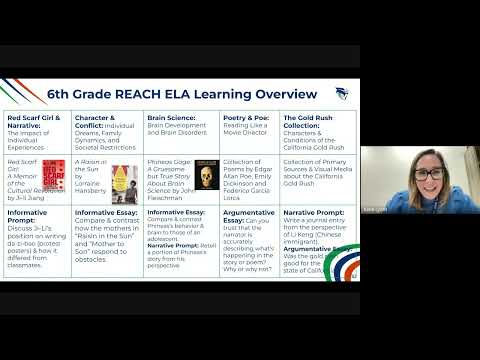
The district laid out a K'0-12 pathway that starts with classroom-based enrichment in kindergarten through second grade and offers formal REACH placements beginning in third grade. For ELA, staff said grades 3'5 use a dedicated 30-minute enrichment block; middle-school REACH students work on standards about one grade level above their cohort, and many REACH students enter English 9 Honors in high school. "In 7th grade, our students are working on 8th grade learning standards," the presentation noted, adding that by eighth grade REACH students may be engaging with ninth-grade texts.
On math, Dave Beatty, the districtDirector of STEM Pathways, described three parallel sequences: core, single-accelerated and the REACH pathway. He said REACH math accelerates students earlier, giving one example: "our students in REACH in 7th grade are taking Algebra," while core-pathway students typically take Algebra 1 in ninth grade. Beatty identified curriculum materials (Eureka Math for grades 3'4; Illustrative Math beginning in grade 5) and outlined high-school options including AP Calculus AB/BC, AP Statistics and ACP (Advanced College Project) dual-credit courses offered in partnership with Indiana University. Staff cautioned that college acceptance of ACP credit varies by institution.
The district also described a Summer Bridge program designed to help students transition into more accelerated pathways (for example, from second to third grade or from fifth to sixth). The Bridge program is a mostly asynchronous, four-week July offering that uses Khan Academy modules; students who register may pay a small optional fee (staff cited $50) for weekly teacher office hours during July. District staff emphasized the Bridge is optional and that students who do not participate are not removed from REACH placements; presenters said many students who skip Bridge catch up during the school year.
Staff walked families through assessments and the appeals timeline used for placement decisions: Spring MAP assessments (administered May 4—5) are used for spring appeals; IAR results are released internally to districts in June for appeals work but are embargoed by the state until about Oct. 30 for public release. The presenters said appeals and double-promotion requests are handled case-by-case and involve developmental review and consultation with school psychologists; staff described skipping a grade or moving between tracks as uncommon and requiring careful readiness checks because a student may skip a full year of mathematics in the process.
Parent leaders summarized REACH Parent Group supports including sponsorship of middle-school math clubs, Noetic Math participation, family math nights and transition panels, and encouraged parents to subscribe to the group's newsletter and ParentSquare for updates. Gina Minnick, who introduced herself as a D205 parent and REACH Parent Group chair, said she maintains a district-linked parent webpage with resources and meeting recaps.
The district closed by saying slides and a recording (with Spanish subtitles) would be shared the next day and that staff would follow up on chat and Google Form questions that could not be answered in the session.
Next steps: the presentation recording and resource links will be posted and staff encouraged families with specific placement or assessment questions to contact the Assistant Superintendent or the REACH team for individualized follow-up.