Get Full Government Meeting Transcripts, Videos, & Alerts Forever!
Get email alerts on the Elections topic
No spam. Unsubscribe anytime.
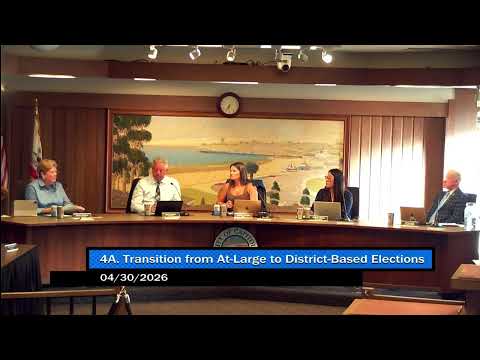
Capitola City Council considers shifting from at‑large to district elections after CVRA demand
Summary
At a special April 30 meeting, the Capitola City Council reviewed a staff recommendation to adopt a resolution of intent to begin transitioning from at‑large to district‑based elections after receiving a CVRA demand letter; staff outlined a tentative timeline and residents voiced both support for moving ahead and concern about rushing the process.
Capitola City Council on April 30 heard a staff presentation and public comment on a proposed resolution declaring the city's intent to begin procedures to transition from at‑large to district‑based elections under California Elections Code section 10010, following receipt of a March 19 demand letter alleging possible California Voting Rights Act (CVRA) violations.
The staff presenter, Mark, told the Council the city received the CVRA demand on March 19 and outlined a tentative schedule that would meet California deadlines: adopt a resolution within the initial 45‑day window, hold two public hearings prior to map drawing (proposed May 14 and May 28), publish draft maps for public review (proposed June 4), hold two post‑map hearings (proposed June 11 and June 25) and adopt final maps by July 23 to preserve options that could extend to July 29 under specified conditions.
Why it matters: The CVRA is designed to prevent minority vote dilution in at‑large election systems, and a demand letter can trigger a process that leads cities to consider district elections to reduce legal risk. The Council must balance legal exposure, community input and practical concerns such as candidate recruitment and residency rules.
Mark emphasized the timeline was tentative and that the legal picture remains unsettled after a recent U.S. Supreme Court decision involving Louisiana; he told the Council the ruling’s precise implications for California law were unclear but that it did not declare the CVRA or federal voting‑rights law unconstitutional. Council members asked whether the Council could halt or revise the process if new legal developments arise; staff said dates can be updated and that staff would continue advising the Council as the law evolves.
Members of the public offered mixed views during the allotted comment period. An unnamed public commenter argued the recent Supreme Court majority opinion constrains race‑conscious districting and urged the Council to pause and seek outside legal advice, saying the demographer and map‑drawing work might be unnecessary. That commenter quoted the court: “Allowing race to play a part in government decision‑making represents a departure from the constitutional rule.”
Teresa Green, who identified herself during public comment, said, “I think this is being rushed,” and urged the Council to move carefully and consider fallback options if districts produce uncontested seats. Jacques Bertrand, a former council member, said districting would change Capitola’s political dynamics and described long‑standing challenges recruiting candidates from Hispanic and other underrepresented communities. Kevin Maguire, a longtime resident, urged stronger residency verification and community‑of‑interest standards for any district maps. Linda Smith, of the Jewel Box community, said she supported moving forward to avoid court costs but asked for confirmation that district voting, as contemplated by the resolution, would not commence before November 2028 and pressed for clear residency rules and transparency about how many draft maps the consultant would produce.
Council deliberations focused on outreach and scheduling. Several council members said the public needs accessible education on what districting would mean — including possible choices about the number of districts and whether to have an at‑large elected mayor — and suggested town‑hall sessions with attorneys and demographers. One council member proposed delaying the first required hearing to May 28 (with informational material on the May 14 meeting), shifting map publication later in June and moving subsequent hearings into July to allow more time for public input while preserving the ability to stop the process at any stage. Staff noted the calendar in the agenda packet had been developed to preserve the 90‑day safe‑harbor window and said the city attorney planned to speak with opposing counsel after any resolution is adopted to seek an extension if possible.
Next steps: The Council is poised to consider adopting a resolution of intent and to schedule public outreach and hearings under a tentative calendar; several members signaled support for additional time and community education before maps are drawn. The record in this meeting does not show a final vote on the resolution. If the Council adopts a resolution, public hearings and draft maps are expected in May–July under the tentative schedule presented by staff.