Get Full Government Meeting Transcripts, Videos, & Alerts Forever!
Get email alerts on the Urban Forestry Cda topic
No spam. Unsubscribe anytime.
Council reviews CDA reauthorization and approves sole-source tree-canopy analysis by UVM
Summary
At a Takoma Park work session council discussed extending the Tacoma Langley Crossroads Development Authority sunset to 2031 and considered a sole-source designation for the University of Vermont Spatial Analysis Laboratory to perform the city’s tree canopy assessment, with council and staff focusing on equity mapping and SHA right-of-way constraints.
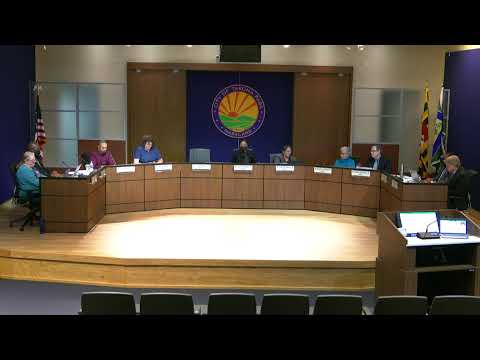
Council members and staff used the April 29 work session to review two interrelated planning matters: reauthorizing the Tacoma Langley Crossroads Development Authority (CDA) and commissioning a tree canopy analysis to guide future planting and equity efforts.
CDA reauthorization: Devon McN of the Housing & Community Development Department explained that the proposed code change is narrowly targeted to extend the CDA’s sunset date by five years (to June 30, 2031), mirroring prior reauthorizations. The change, McN said, is limited to the expiration date and does not amend other governance provisions in code. Public commenter Javier Rivas, executive director of the Tacoma Langley Crossroads Development Authority, urged reauthorization to avoid service interruption and said the CDA’s work supports immigrant- and minority-owned small businesses through outreach, promotion and direct assistance.
Council members asked procedural and governance questions: whether the temporary sunset was linked to specific code provisions, whether the CDA’s boundary is limited to Takoma Park, and how (or whether) the council issues formal goals or resolutions directing the CDA. Staff said Maryland law authorizes creation of commercial-district management authorities but that the city’s code governs the CDA’s structure; council members discussed but did not adopt any substantive changes to the ordinance language at the work session.
Tree canopy assessment (University of Vermont): Staff recommended designating the University of Vermont Spatial Analysis Laboratory as a sole-source contractor to maintain consistency with prior canopy studies. Staff described the assessment’s purpose: quantify canopy gains and losses, locate inequitable distributions of tree cover, and provide continuity with historic data to guide urban-forestry planning.
Council discussion focused on data uses and limits: members asked whether the UVM analysis can be combined with GIS layers (bus stops, sidewalks) to prioritize plantings; staff confirmed the analysis can be layered with other datasets. Urban forestry staff (Rudy Dulac) cautioned that aerial analyses are a starting point and that on-the-ground verification will be necessary for detailed site-level decisions. Dulac also warned that planting along University Boulevard could require coordination and permission from the Maryland State Highway Administration (SHA) because SHA controls that right-of-way; trees planted on SHA right-of-way may not be protected under city code without SHA agreement.
Next steps: Councilmembers expressed general support for the CDA reauthorization and for moving forward with the tree-canopy analysis; both items were slated for formal consideration at the upcoming voting session. Staff will prepare the ordinance language for CDA reauthorization and the sole-source documentation for the tree-canopy procurement.