Get Full Government Meeting Transcripts, Videos, & Alerts Forever!
Get email alerts on the Live Entertainment Pilot topic
No spam. Unsubscribe anytime.
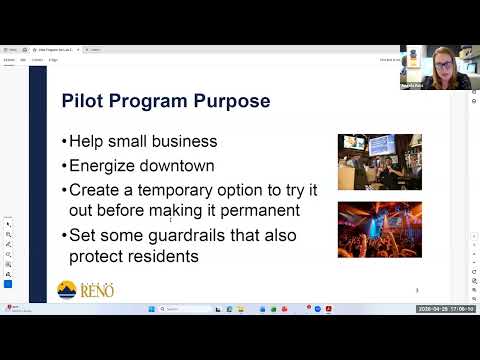
Reno staff propose 18-month pilot to let indoor venues host live entertainment downtown without conditional use permits
Summary
City of Reno Development Services staff outlined a temporary pilot that would allow indoor live entertainment in the downtown entertainment core without a conditional use permit—provided operators hold a cabaret license and an approved security plan; residents urged metrics, decibel limits and clearer enforcement.
City of Reno Development Services staff on a public webinar presented a proposed 18-month pilot allowing indoor live entertainment in the downtown "entertainment core" without the city’s usual conditional use permit (CUP), while requiring a cabaret license and a tailored security plan reviewed by police and other departments.
"What we're going to be talking about is a pilot program related to live entertainment," Angela Foos, a Development Services staff member, told attendees, summarizing council direction to test ways to encourage business activity while protecting downtown residents. Foos said the current rule allows live entertainment citywide through 11 p.m., but indoor performances after 11 p.m. now trigger a CUP that typically costs about $5,000 and takes roughly three months.
Under the draft pilot, businesses inside the downtown/midtown entertainment core would be able to operate indoor live entertainment by right during the trial period without obtaining a CUP, Foos said, but they would still need to secure a cabaret license and submit a security plan tailored to their operation. "We do ask that they put together a plan of how their bouncers will handle kind of crowd control," Foos said, describing coordinated review by police, code enforcement, planning and business licensing.
The staff presentation emphasized limits: the pilot would apply only to indoor entertainment, and only within the designated entertainment core (the 4th Street corridor/midtown area), not citywide. Foos said staff reserve the right to require operators to revise plans, increase security training or personnel, and to revoke a cabaret license if an operator repeatedly violates safety commitments. "If you continue to be a bad operator, we reserve the right to potentially remove your cabaret license," she said.
Public commenters raised concerns about noise, enforcement and how the city will measure success. "I don't see any reference to noise here," said Art Ringel, a downtown resident, who said electronic dance music has been the main noise source in his experience and urged that building acoustics and numeric decibel limits be considered. Another attendee asked how the city would evaluate success and requested a cost-benefit analysis; Foos replied that metric-setting and follow-up are matters council will decide and that the pilot is intended to produce data staff can present back to council during and after the trial.
Supporters and skeptics both spoke during the webinar. Edward Goodrich said experimenting is useful but recommended specific acoustic or decibel thresholds: "If you can minimize that, I think downtown will be a much much safer place than it is today," he said. In the webinar Foos also encouraged residents to use the Reno Direct line or staff email to report problem operators so staff can follow up.
Next steps: staff will present the draft language to the planning commission next week for a zoning recommendation and then to the City Council in June for the two required readings. Staff asked the public to review the draft language on the city webpage and to send comments to foosa@reno.gov ahead of the hearings.
The pilot remains a staff proposal; council must still approve the ordinance changes and any longer-term adjustments at future hearings.