Get Full Government Meeting Transcripts, Videos, & Alerts Forever!
Get email alerts on the Police Equipment topic
No spam. Unsubscribe anytime.
Pleasant Hill police present AB 481 equipment report, listing drones, breaching shotgun and less-lethal gear
Summary
Lieutenant Brian Leonard presented Pleasant Hill Police Department’s AB 481 report on April 28, 2026, detailing an inventory that includes drones, a breaching shotgun, specialized ammunition, flashbangs, less-lethal launchers and allied armored vehicles; documents and video are posted on the department’s transparency portal.
On April 28, 2026, at 3 p.m., Lieutenant Brian Leonard of the Pleasant Hill Police Department presented the department’s AB 481 (military equipment) report and inventory for public review. The presentation summarized what the department owns, what it can access through mutual-aid agreements, training requirements and annual maintenance costs, and pointed listeners to the department’s transparency portal and the city’s YouTube page for documents and video.
AB 481, Leonard said, was “passed in 2021 and came into effect January of 2022,” and requires that police departments report on military equipment they own or can access so City Council can exercise oversight and the public can have greater transparency. He also said Pleasant Hill readopted Ordinance 954 earlier in April 2026 and that Department Policy 706 (specialized or military equipment) is available for review online.
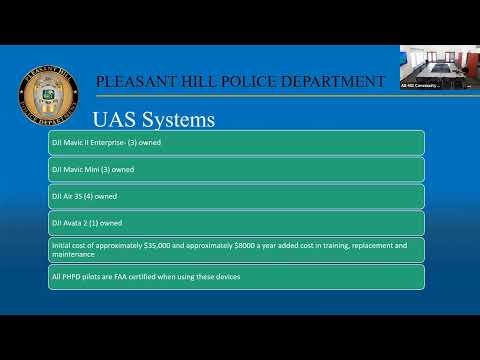
Leonard gave specific inventories and training and cost details. For unmanned aircraft systems (UAS or drones) he listed four models the department owns: three DJI Mavic 2 Enterprise, three DJI Mavic Mini, four DJI Air 3S and one DJI Avata. He said the initial purchase cost for the drone program was “about $35,000” with “approximately $8,000 a year” for training, maintenance and replacements, and that department pilots are RFAA certified. He described uses for drones as that they “can be used to enhance the department’s mission of protecting lives and property” for search-and-rescue, suspect apprehension, crime-scene and traffic-collision documentation, tactical operations and legally authorized surveillance.
On breaching tools, Leonard said Pleasant Hill owns a single explosive breaching shotgun (a modified Remington 870) and 40 compressed-copper 12-gauge breaching rounds. He gave an initial cost estimate of about $800 and said users must complete an 80-hour POST-certified SWAT breachers course. He described the tool’s typical use as breaching heavy doors by damaging hinge mechanisms rather than locks.
The department also reported specialized ammunition that the presenter distinguished by coverage under AB 481: .223 rounds are not covered while .308 rounds are. Leonard said the department’s specialized inventory includes limited-penetration rounds (designed to deposit energy quickly and reduce overpenetration), tactical barricade rounds (designed to reduce fragmentation), and armor-piercing rounds (described as having a tungsten-carbide core to penetrate light armor). He estimated initial costs at approximately $2,000 and annual maintenance at about $1,000; personnel using these rounds must complete an 80-hour POST-certified SWAT sniper course.
Leonard listed 24 flashbangs (light-sound diversionary devices) with initial cost around $1,200 and about $600 annually to maintain inventory; he said their purpose is to distract armed or dangerous subjects and that use requires a POST-certified SWAT operator course with annual recertification. The department also reported owning 14 40mm less-lethal launchers (for direct-impact foam rounds) and 10 Remington 870 shotguns outfitted or painted to indicate less-lethal use; Leonard said both require initial certification and annual training and that resupply costs vary by year.
He distinguished equipment Pleasant Hill owns from assets maintained by partner agencies that are available through mutual aid. Examples cited include an avatar robot owned by the Walnut Creek Police Department bomb squad for remote inspection and a Lenco BearCat armored rescue vehicle owned by the San Ramon Police Department and deployed by Central County SWAT; Leonard noted the BearCat is bullet resistant up to .50 caliber and vehicle operators must attend a 24-hour POST-certified course. He also listed a San Ramon Valley Fire District communications/command truck used for mobile dispatch and a Walnut Creek–owned Long Range Acoustic Device (LRAD) for announcements and de-escalation; Leonard emphasized those tools are used only by trained personnel in accordance with policy and applicable law.
Leonard summarized Pleasant Hill PD’s overall position on the inventory: “all of the equipment owned by Pleasant Hill PD is traditional law enforcement equipment. There's nothing exotic.” He closed by noting there were no live-stream participants with questions and reiterated that the presentation recording and related documents will be posted on the city YouTube page and the department’s transparency portal.
The presentation provided counts, training requirements and rough cost estimates but did not include budget line-item sources or specific operational protocols beyond references to Policy 706 and POST-certified training requirements. No motions or votes occurred during the presentation; the session was informational and concluded with the posted materials and video as the primary public record of the briefing.