Get Full Government Meeting Transcripts, Videos, & Alerts Forever!
Get email alerts on the Budget topic
No spam. Unsubscribe anytime.
Gates County commissioners weigh using school capital reserve to fund universal school meals and tech support
Summary
At a June 2, 2025 reconvened meeting, the Gates County Board of Commissioners reviewed options for the FY 2025–26 budget including a $130,000 one‑year allocation for universal school breakfast and lunch from the school capital reserve, proration of school tech support, a proposed COLA, and whether to draw on fund balance or raise taxes.
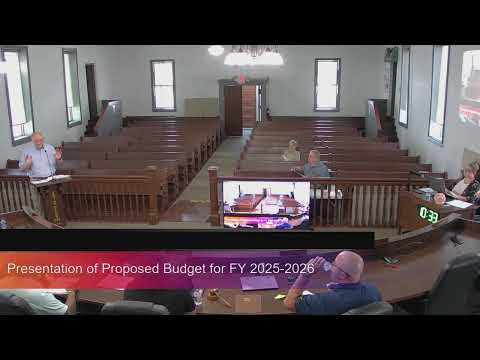
Emily Truman, chair of the Gates County Board of Commissioners, reconvened the board on June 2 to continue discussion of the proposed fiscal year 2025–26 budget and asked staff for updated scenarios on how the board could fund items raised at an earlier work session.
County Manager Scott Sour presented options the finance team had prepared. He said one option would be to use up to $130,000 from the school capital reserve to fund a one‑year universal breakfast and lunch program for Gates County students, with the hope that a quarter‑cent sales tax referendum (referred to in the meeting as "Article 46") could be placed on an upcoming ballot to sustain the program if approved. Sour also said the board could prorate a $200,000 request for technical support to $120,000 to serve three of the five school campuses immediately; both items together would total roughly $250,000 drawn from the school capital reserve, which staff described as holding about $2.2 million at present.
Sour laid out other line items and how they mapped to hypothetical 1‑cent tax increments: an exceptional children (EC) program gap he said the school prioritized at $150,000; a cost‑of‑living adjustment that staff modeled as a 3% COLA but that staff estimated would net about $120,000 after state and federal reimbursements; and a roughly $100,000 facility upgrade tied to relocating transportation to the county annex. "One scenario could involve a 3 cent tax increase above revenue neutral to place the rate at 69 cents," Sour said as an illustrative projection, and he stressed that staff had prepared a score sheet breaking costs down by program and fund.
Commissioners pressed staff for detail and alternatives. Several commissioners questioned whether one‑time or capital items — including the transportation relocation — should instead be paid from fund balance or the capital account rather than from ongoing operating revenue. Chair Truman and others proposed using school capital reserves for the school nutrition and computer expenses to keep those costs out of the operating budget for the coming year.
There was clear discussion about the appropriate size of a COLA. While the draft modeling had used 3%, multiple commissioners argued for a 2% increase based on regional benchmarks; staff cited a regional figure near 1.987%. "The four here though seem comfortable with the 2% COLA," Chair Truman said, signaling preliminary support for that lower figure.
Commissioner Dave Foresight objected to tapping fund balance for both balancing the budget and to support a tax increase. "I don't agree with us taking money out of fund balance to balance our budget and then also increase taxes," Foresight said, adding he favored trimming one‑time expenditures and delaying certain capital projects this year rather than raising revenue.
Other operational questions arose: commissioners asked whether social services still sought a new quality‑assurance lead position (a maintenance level three) and whether the county should revise overtime and comp‑time practices. Commissioners also urged the schools to provide a multi‑year computer replacement schedule so future budgets can stagger purchases; one suggestion was to set aside $25,000–$30,000 annually to avoid simultaneous large‑scale replacements.
Chair Truman said she would meet with the school board before the board's June 18 meeting to verify whether $130,000 is sufficient to cover the universal meal program for one year and to assemble all school and federal allocations so the board could see the funding gap clearly. Staff emphasized the public hearing and current discussion were not final and said they would prepare scenarios that most closely reflected a majority view for the board to consider.
The board set a follow‑up budget discussion for June 18, 2025; a motion to adjourn was then made, seconded and approved.