Get Full Government Meeting Transcripts, Videos, & Alerts Forever!
Get email alerts on the Graduate Research Fellowship topic
No spam. Unsubscribe anytime.
NIJ details FY25 Graduate Research Fellowship: up to $60,000 a year, new data and minimum-duration rules
Summary
NIJ program managers outlined the FY25 Graduate Research Fellowship NOFO, including deadlines (SF-424 due May 19; full package due May 27), awards of up to $60,000 per year (41k salary, 16k education, 3k research), expected funding of about eight fellows, and new requirements such as a required data-management plan and a 12-month minimum project period.
The National Institute of Justice on the Office of Justice Programs’ behalf detailed its Fiscal Year 2025 Graduate Research Fellowship (GRF) competition in a public webinar, saying the program will provide up to $60,000 per year for doctoral students conducting dissertation research related to criminal justice.
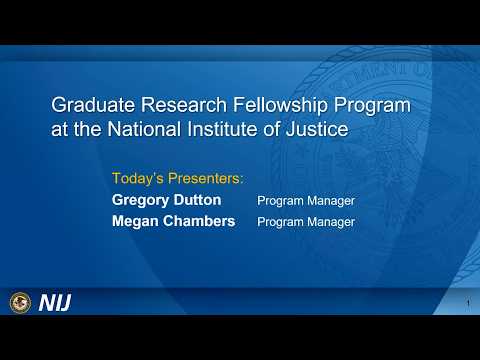
NIJ program managers Greg Dutton and Megan Chambers opened the webinar by noting the NOFO (notice of funding opportunity) for GRF opened March 25 and closes May 27, with a two-step submission process: an SF-424 form filed at grants.gov by May 19 and the full application package submitted in DOJ’s JustGrants system by May 27. NIJ expects to fund about eight new fellows this year and said award announcements are typically made by the end of September.
Why it matters: GRF is one of NIJ’s longest-running fellowship programs and supports doctoral research that NIJ says advances knowledge on preventing and controlling crime, enforcing the law, promoting public safety, protecting the border, or ensuring fair administration of criminal or juvenile justice. Dutton noted the program is competitive—the 2024 success rate was about 16 percent—and that fellows are expected to produce research and archived data that can inform practitioners and policymakers.
Program terms and new requirements: Chambers said the fellowship can provide up to $60,000 annually for up to three years within a five-year period. "Forty-one thousand annually can be put towards student salary and fringe benefits, up to $16,000 annually for a cost of education allowance, and then $3,000 annually for research expenses," she said. NIJ emphasized that awards are one-time and cannot be supplemented later; applicants should request the full amount they expect to need.
Dutton outlined several FY25 changes applicants must note: a required data management, sharing, and archiving plan; a requirement that author-accepted manuscripts of peer-reviewed publications resulting from the grant be deposited in a public access repository; a reduced program narrative page limit of eight pages; and a new minimum project period of 12 months. "There is now a minimum allowed project period of 12 months," he said, explaining that very short projects proved administratively impractical.
Eligibility and application logistics: Chambers said applicants must be enrolled full time in a U.S. accredited research doctoral program at the time of application; the university is the official applicant and submits the package on the student’s behalf. She clarified that IRB approval and formal dissertation topic approval are not required at submission but must be completed before fellowship funds will be released if the applicant is awarded.
Merit review and priorities: NIJ will route applications to panels of external academic reviewers by field, with project design and implementation carrying the largest weight in reviews. Dutton said the NIJ director makes final award decisions and may consider program priorities—NIJ will give priority consideration to proposals that directly support law enforcement operations (including immigration law enforcement operations), combat violent crime, protect children, or support victims of trafficking and sexual assault, among other priorities.
Frequently asked questions and clarifications: During a lengthy Q&A, presenters said unofficial transcripts are acceptable, reviewer comments are returned to all applicants (funded and not), and NIJ does not impose a student citizenship requirement because grants are made to universities (students must be eligible under university payment policies). Dutton also advised that letters of support from outside agencies are useful when an agency relationship is essential to project feasibility, but the required committee-chair statement of support is mandatory for every applicant.
Next steps: NIJ encouraged prospective applicants to read the NOFO closely, consult the GRF program page and FAQs, contact their university research office early, and assemble the six critical application elements (proposal narrative, budget web form, verification of enrollment, undergraduate and graduate transcripts, committee-chair statement of support, and a CV/resume/biosketch). The webinar will be recorded and a transcript posted for later reference.
The webinar closed with NIJ staff inviting applications and saying they look forward to reviewing proposals.