Get Full Government Meeting Transcripts, Videos, & Alerts Forever!
Get email alerts on the School Budget topic
No spam. Unsubscribe anytime.
Gettysburg Area School District budget hearing: special-education costs push proposed increase; administration recommends 3.5%
Summary
At a May 4 board hearing, district staff said moving special-education services in-house and rising contract, transportation and benefits costs are the primary drivers of a proposed budget that would allow up to a 4.2% tax increase; administration recommended lowering that to 3.5% and offered capital-plan and staffing options to reduce the gap.
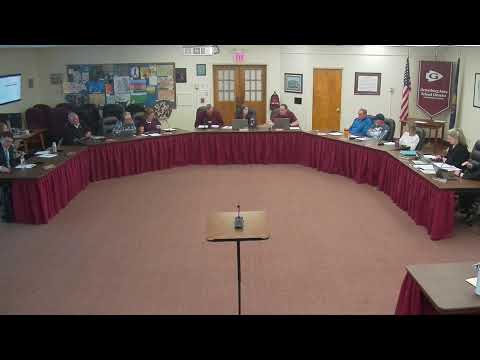
Gettysburg Area School District held a public budget hearing on May 4 as administrators presented a proposed budget that would allow a maximum 4.2% local tax increase and related scenarios, and explained that a surge in special-education responsibilities is the principal driver of higher costs.
Belinda, the district presenter, told the board that "the comprehensive special education plan is really what's driving most of this budget," citing a faster-than-expected transfer of services from the intermediate unit (IU) that requires the district to supervise more classrooms and students directly. She said the district expects to add about 50 students to its special-education caseload as IU programs return to district oversight.
Why it matters: administrators warned that without targeted choices the district will need to rely on unassigned fund balance and assigned reserves to balance the tax-and-spending equation. Belinda said the district finished the prior year with a $4.7 million beginning fund balance but recommended a 3.5% tax-rate increase — below the 4.2% cap in the proposed budget — to reduce reliance on fund balance and to allow the board time to adopt targeted reductions.
Special education and staffing changes
District staff laid out multiple staffing changes tied to the IU transition. Belinda described shifting contractor family-navigator roles to in‑house social-worker positions and presented a line item for an additional social worker; she also proposed hiring a second special-education supervisor (to split elementary and secondary supervision) to meet increased oversight demands, noting an administrative salary-and-benefits impact "about $168,208" in the materials provided to the board.
Director of student services Brandy Glennacres explained the operational consequences: "We attend about 10 [Hoffman Homes] meetings per month for Hoffman alone," and the district currently participates in roughly 100 IU-related meetings annually. "When we bring the classroom back... we are now supervising those classrooms and it's full," she said, adding that the extra workload — including IEPs, re-evaluations and compliance monitoring — makes a second supervisor necessary.
Board members pressed for detail on mandated class sizes and paraprofessional needs. Brandy summarized typical ratios for autistic-support classrooms (a common low-density configuration is eight full‑time AS students, with some flexibility to expand to combined AS/life-skills rooms where appropriate), and said an extra paraprofessional typically appears when classroom counts rise above six or seven students.
Operations, contracts and benefits
Administrators also pointed to contract-driven cost increases across transportation, professional services and benefits. Belinda said many contracts have automatic index-related increases tied to state formulas — giving transportation as an example — and that salary-contract steps account for a roughly 3.95% labor increase in the current proposal. She also outlined health-care and retirement cost pressures: the district's health plan assumption is up (the presentation cited a 6% medical-cost increase) and the retirement contribution rate (referred to in the presentation as "piecers") remains a substantial budget factor.
Technology, capital and reserves
The administration proposed adding a classified building IT technician to reduce third-party vendor spend and relieve a single staff member logging heavy overtime. "This additional position will reduce that overtime need," Belinda said, noting cyber‑security and device‑support duties have expanded.
On capital spending, staff presented choices: keep a $1 million annual capital transfer, limit the capital transfer to the year-one need of $660,822, or defer several nonessential items — two LED signs, a concession-stand hood/grill and terazzo repairs — which would lower year-one capital to about $499,977. Bond fund balances and constraints were discussed at length; administrators said roughly $3.9 million remains in bond proceeds restricted for major projects (team room and admin-HVAC planning) and cautioned that bond proceeds must be spent within IRS spend-down rules to avoid arbitrage liabilities.
Revenue pressures and scenarios
Belinda told the board that federal Title I awards are expected to fall (presentation cited a possible $68,000 reduction) and that homestead/farmstead state allocations had been modestly revised downward in the state's certification. Taken together with the special-education increases, she said the administration's reasonable path was recommending a 3.5% local tax-rate increase rather than immediately adopting the 4.2% index cap presented in the proposed budget.
Board directions and next steps
Board members asked staff to return on May 18 with several variants: a budget built at 2.9%, at 3.5% and at the 4.2% index; a version that removes the four nonessential capital items; summer cash-flow ("burn rate") showing how much unassigned fund balance is needed to pay July–August bills; and a clearer comparison of the net effect of IU transfers (reduced IU payments versus added district salary/benefit lines). Administrators agreed to provide the additional scenarios and to show the difference between moving IU costs from 300-series object codes to 100‑series salary lines so board members can see net changes.
Votes and routine business
The board approved routine consent items (agenda items 51–53 and meeting minutes) and later approved human-resources recommendations; the HR vote recorded one abstention.
Bottom line: administrators recommended a cautious 3.5% increase and offered specific, board‑level choices (defer nonessential capital, reduce the capital transfer, or adopt a larger tax rate) to close the gap created chiefly by special-education expansion. Staff will return with multiple budget scenarios and clarifying financial detail at the May 18 meeting for a final decision at the June meeting.
Ending note: the board asked staff for greater specificity about summer cash needs and a detailed reconciliation showing how much of the IU-related costs are true new district expenditures versus accounting transfers from IU object codes to district salary/benefit lines.