Get Full Government Meeting Transcripts, Videos, & Alerts Forever!
Get email alerts on the Minimum Wage topic
No spam. Unsubscribe anytime.
DeKalb County raises minimum wage for county employees to $19 an hour
Summary
DeKalb County officials announced an immediate increase in the county minimum wage to $19 an hour, affecting 1,428 regular-status employees across 34 divisions and costing about $2.7 million annually; county leaders said the change was implemented to address affordability, recruitment and pay compression and will not trigger a tax increase.
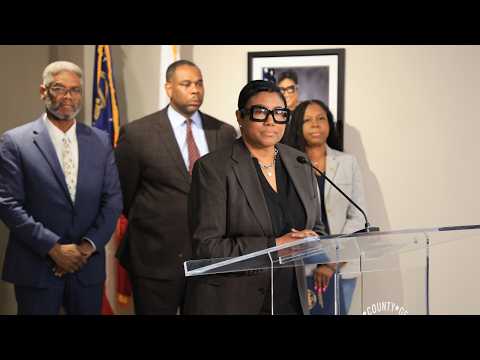
DeKalb County announced an immediate increase in its county minimum wage to $19 an hour, county CEO Lorraine Cochran-Johnson said at a press conference. The county said the action affects 1,428 regular-status employees across departments and divisions and that the change was reflected in employees' May 1 paychecks.
Cochran-Johnson framed the pay change as a budgetary priority and a moral decision, citing a 2022 Ernst & Young study she commissioned that, she said, showed minimum-wage workers in metro Atlanta could need to work 140 hours a week to afford a two-bedroom apartment. "No one who works full-time in public service should be struggling to make ends meet," Cochran-Johnson said, announcing the increase effective immediately to address that gap and to improve recruitment and retention.
Interim human resources director Jadira Haynes outlined how the adjustment was structured. "First, all regular status employees earning below $19 an hour were brought up to the new minimum county wage of $19 an hour," Haynes said, adding that 563 employees were moved to the new minimum. "Second, compression adjustments were applied to employees earning up to $22.68 an hour," she said, benefiting an additional 865 employees. Haynes said in total 1,428 regular-status employees, both full-time and part-time, received a pay increase reflected in their May 1 paycheck.
The county said the adjustments cover nearly every function of county government, including public safety, courts and legal services, infrastructure, community services and administrative functions. Haynes described the changes as placing DeKalb among the higher-paying county employers in the metro Atlanta area.
T.J. Singler, the county's director of management and budget, told reporters the annual additional cost is about $2.7 million and said the increases will not require a tax increase. "No," Singler said in response to a question about tax changes; he attributed the funding to budget priorities and fiscal accountability measures.
Reporters asked how the pay changes would show up on employee paychecks. Haynes said the county calculated an average increase of about 7.4 percent for affected workers and offered to provide example paycheck breakdowns because individual impacts vary by prior wage and hours worked. The county also said it has undertaken a broader pay-and-class study, nearing completion, to address salary structure and compression across roles.
Cochran-Johnson said the decision was also driven by staffing and retention concerns. She noted the county had lost officers in recent years and faced high overtime costs, which the county redirected in part to support salary increases. "There is an inherent cost with training employees, with the recruitment of employees, and we can't afford to continue losing institutional knowledge," she said, adding that compression adjustments were intended to respect tenure and maintain fair pay separation.
County officials said the salary move is the beginning of a more comprehensive effort informed by the pay-and-class study; they encouraged other jurisdictions to "lean in" on wages for frontline workers. No formal vote or ordinance was recorded at the event; officials described the action as a budgetary implementation and executive prioritization.