Get Full Government Meeting Transcripts, Videos, & Alerts Forever!
Get email alerts on the Ai Policy topic
No spam. Unsubscribe anytime.
Pennridge board holds first reading of student generative-AI policy; parents could opt out via acceptable-use process
Summary
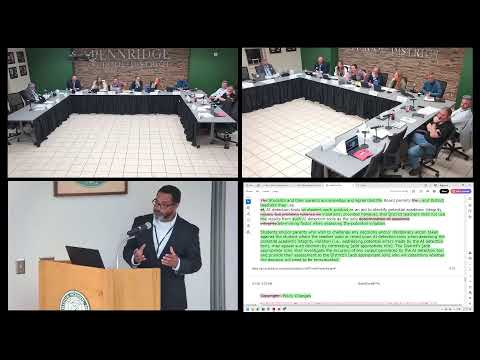
At a policy committee session, Pennridge officials held a first reading of Policy 815.2 on student use of generative AI. The proposal would govern district-provided devices, enable per-device disabling of embedded AI tools for students whose parents opt out via the annual acceptable-use form, and defer disciplinary details to an administrative regulation.
Pennridge School District’s policy committee held a first reading of a proposed policy (815.2) that would govern student use of generative artificial intelligence on district-provided devices.
Mr. Johnson introduced the draft policy and said the board would move forward with a second reading while staff develop an administrative regulation (AR) that can be updated more frequently as the technology evolves. The AR is intended to specify implementation details such as grade-level permitted uses, consent forms, disciplinary steps and appeals procedures.
The committee discussed how parents would register consent and how IT would operationalize restrictions. Staff recommended adding AI consent to the district’s annual acceptable-use form (PowerSchool) so parents could opt their child out of district AI tools; IT staff confirmed district technicians can disable embedded features (for example, co-pilot) on individual student devices. Committee members emphasized that policy coverage applies to district-issued devices and district‑approved tools rather than all AI a student could access at home.
Members also highlighted the need for: parent and student education (community information nights and fact sheets), grade-differentiated guidance (elementary vs. middle vs. high school use), teacher professional development, and student advisory input on parameters. The draft policy notes consequences for misuse but committee members agreed that specific disciplinary steps and appeals processes should be detailed in the AR rather than the policy to allow faster updates.
Technical and legal topics surfaced in discussion, including whether inputs to district enterprise AI instances are used to train vendor models (staff explained enterprise configurations can be set to prevent community model training and that teachers should avoid submitting personally identifying information), and how to treat derivative outputs for ownership/copyright. The district will consult counsel and IT as it prepares the AR. The committee scheduled a second reading of the student policy and plans a separate staff AI policy first reading in the fall.
No vote was taken at the committee meeting. Staff will draft an AR with implementation tables, a parent-facing fact sheet and recommended consent language for PowerSchool.