Get Full Government Meeting Transcripts, Videos, & Alerts Forever!
Get email alerts on the School Budget topic
No spam. Unsubscribe anytime.
Ridgewood board adopts 4% tax levy to cover soaring health‑benefit costs; budget passes 5‑0
Summary
The Ridgewood Board of Education approved the 2026–27 final budget May 4, 2026, voting to raise the local tax levy by 4% to help offset large health‑benefit premium increases. Officials said $1.66 million in savings from moving off the state plan reduced the cuts needed, but staffing consolidations and changes to courtesy busing remain under review.
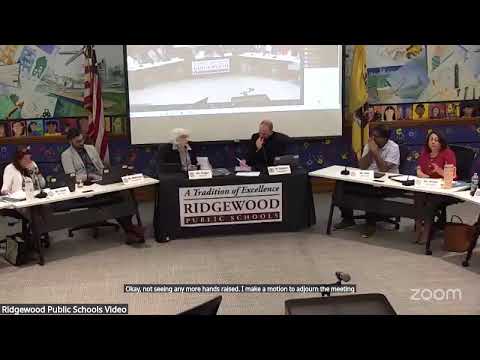
The Ridgewood Board of Education on May 4 adopted its 2026–27 final budget and voted to raise the local tax levy by 4% after administrators warned of sharply rising health‑benefit costs and declining state aid.
Superintendent Dr. Troy Schwarz and business official Mr. Matthews presented the budget at a public hearing, telling residents that the district faced a two‑year trend of higher health‑care premiums and other cost pressures. "This has been a very challenging budget process," Dr. Schwarz said, asking the public to consider the trade‑offs between maintaining programs and fiscal restraint.
The administration said an early procurement effort to leave the state health plan and bundle benefits produced roughly $1.66 million in savings that helped mitigate the full impact of premium increases. "We were able to get out of the state health benefit plan ... which saved the district 1.66 million," Mr. Matthews said during the presentation. Even with that change, presenters said employee benefits and other cost drivers required a revenue increase.
The 4% tax‑levy increase was presented as a modeled solution inside the state's levy cap framework (the presentation cited the state statute used for waivers). Officials estimated the levy would add about $527 a year for the average assessed home of about $715,000 (roughly $44 a month), acknowledging that individual homeowner impacts vary with assessed value and municipal timing.
To reduce spending, administration described a series of efficiency measures: a zero‑based review of non‑salary lines, vendor renegotiations, some position consolidations and an evaluation of subscription busing to replace some courtesy routes. Officials said roughly 17 position efficiencies were identified; while many were handled through attrition or transfers, presenters said a small number of staff — discussed in the meeting as seven individually identified impacted staff in one list — were told they did not have a position for next year. Dr. Schwarz emphasized efforts to prioritize vacancies and to minimize layoffs where possible.
The board adopted the budget by roll call. "I move the 2026–27 budget," the motion stated, and tallying the roll call returned five affirmative votes. The board recorded reserved concerns about the selection of some facilities projects and about particular hazardous routes that are still under review.
What the district will do next: administrators said they will continue to finalize decisions about which courtesy‑bus routes might be converted to subscription service and will work with local officials on hazardous‑route determinations; they also said they are vetting options to avoid eliminating certain early‑childhood services. The board scheduled follow‑ups at committee level and the facilities committee expects to act on several bid recommendations in the coming weeks.
The budget adoption sets the district's revenue and spending plan for 2026–27; procedural questions remain on how transportation and some programmatic changes will be implemented in the fall.