Get Full Government Meeting Transcripts, Videos, & Alerts Forever!
Get email alerts on the Consumer Protection topic
No spam. Unsubscribe anytime.
Senate approves law restricting use of personal surveillance data for individualized prices and wages
Summary
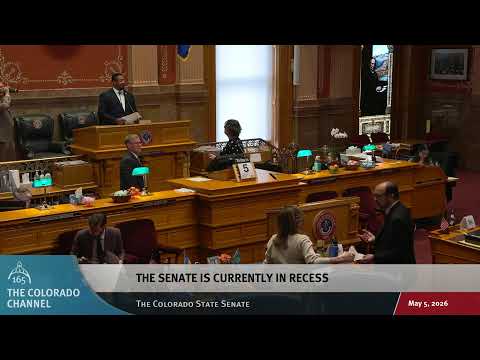
After hours of floor debate and multiple amendments, the Colorado Senate passed House Bill 1210, limiting businesses' ability to set individualized prices or wages based on surveillance-derived personal data while carving out banks, insurers and certain lending activities.
House Bill 1210, a measure to restrict so-called "surveillance pricing," passed the Colorado Senate on May 5 after an extended floor debate and several amendments.
Advocates and sponsors framed the bill as a consumer-protection measure aimed at preventing companies from using intimate personal data'such as browsing history or geolocation'to charge different prices or set wages based on an individual's perceived vulnerability. "Everybody understands that our phones have become an extension of our brains," said Senator Judah during floor debate, describing how personal searches and location data can be repurposed to vary prices for the same product.
The bill's sponsor and floor manager, Senator Weissman, said the text was narrowly crafted with multiple exclusions and safeguards. "This bill has been narrowly crafted," Weissman said, calling it a targeted consumer-protection effort and explaining that the measure defines "individualized price setting" and then lists specific exclusions that preserve routine commercial activity.
Key amendments debated and resolved on the floor included: - L18 and L36: clarifications negotiated with ride-share, delivery network firms, insurers and related stakeholders to refine definitions and preserve existing industry regulatory frameworks; L36 explicitly exempts insurers subject to existing insurance statutes and rules. Both were adopted. - L19, L23, L20 and L27: attempts to narrow or broaden the bill'for example, by requiring a knowing mental state for violations (L19) or restricting prohibitions only to pricing based on protected characteristics (L23). These amendments were rejected after debate. - L40: a clarifying amendment negotiated with banking and mortgage stakeholders carved out customary lending practices and confirmed that traditional underwriting remains governed by existing law; this amendment was adopted.
Supporters emphasized harm to vulnerable consumers and the scale of private-sector data gathering. "When demand rises, prices for everyone equally'that's how markets should work," Senator Judah said, contrasting that principle with "surveillance pricing," which he said "rigs the market." Proponents argued the bill preserves common commercial practices such as loyalty programs and explicitly lists multiple exclusions.
Opponents cautioned about enforcement burdens and unintended market effects. Some senators warned the bill could impose costs on small businesses and create regulatory uncertainty for algorithmic pricing that is supply-and-demand driven. Lawmakers debated the proper burden of proof and the degree to which the Attorney General's office would be resourced to enforce the new provisions.
Procedural and enforcement details: the bill was added into the Colorado Consumer Protection framework on the floor, and the adopted amendments narrow scope for the insurance and lending sectors so those regulated industries remain primarily accountable under their existing statutes and supervision. The final text retains definitions of individualized price and wage algorithms while excluding standard loyalty discounts and many routine commercial practices.
The Senate adopted the amended bill by voice vote; floor statements show the measure passed and was ordered to enrollment for delivery. The bill now proceeds toward final enrollment and transmittal to the governor as the legislature heads toward the close of the session.