Get Full Government Meeting Transcripts, Videos, & Alerts Forever!
Get email alerts on the Environment Conservation topic
No spam. Unsubscribe anytime.
Balcones Canyonlands marks 30 years; officials outline permit renewal and Travis County visitor center plans
Summary
City and county officials celebrated the 30th anniversary of the Balcones Canyonlands Conservation Plan, described species protections and restoration work, and said a multi-phase federal permit renewal will proceed while Travis County builds a 60,000-square-foot visitors center expected to open in 2028.
Austin and Travis County officials on May 1 marked the 30th anniversary of the Balcones Canyonlands Conservation Plan, highlighting decades of habitat protection and detailing plans to renew the plan's federal incidental take permit while the county builds a new visitors center, officials said.
Kimberly Harvey, BCCP secretary, opened the presentation by framing the anniversary as both a recap and an outlook: "We're going to tell the story so far and give a look at what's to come," she said.
The presentation traced the BCCP's origins from the Endangered Species Act and early regional activism, and described how the plan established a system of preserves to meet mitigation commitments. Harvey said the original permit set preservation targets including roughly 28,428 acres of habitat for the golden-cheeked warbler and about 2,000 acres for additional habitat and named caves. Presenters said partners now steward more than 33,000 acres and 62 named caves across western Travis County, exceeding the original minimums.
Olivia Lopez, the City of Austin's environmental conservation program manager, emphasized scale and public access: the preserve system includes widely used public spaces and, according to staff, has supported more than 1,500 private landowner and developer permits and over 400 public infrastructure projects since the plan began.
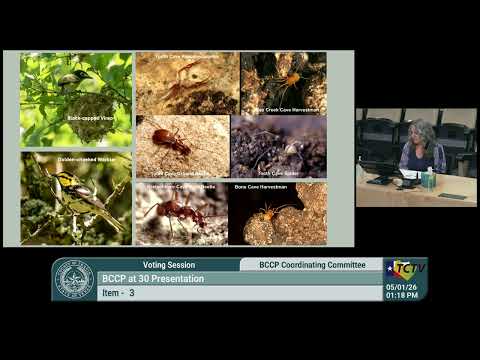
Jeremy Hull, assistant director of natural resources for Travis County, outlined species and restoration results. "In 2006, staff had 13 confirmed individuals over nine different territories. In 2025, that number grew to 73 confirmed individuals over 57 territories," Hull said, describing survey results for the black-capped vireo and attributing gains to active habitat management. Hull and other staff also highlighted protections for six cave-dwelling invertebrates and cited a six-year restoration of Midnight Cave that removed debris and increased species abundance while also improving aquifer recharge.
Officials framed permit renewal as a regulatory and scientific update, not a pause in services. Harvey said U.S. Fish and Wildlife Service guidance treats any amendment or renewal as a new Service decision subject to current law and best-available science, so the BCCP renewal will follow a multi-phase process that keeps BCCP permitting active during review. The phases described include consultant procurement and local approvals, aligning science and stakeholder input with drafting, federal NEPA review and public comment, and finalization and implementation.
Hull announced that Travis County will build a Balcones Canyonlands Preserve visitors center: a three-story, 60,000-square-foot facility on a 93-acre site adjacent to preserve land near 620, intended to open in 2028. The center is planned to include immersive exhibits, native-plant gardens, ADA-accessible trails, an amphitheater and office space for natural-resources staff.
Mark Fischer of the U.S. Fish and Wildlife Service called the BCCP "a wonderful example of success" and thanked the many partners and volunteers who helped create and sustain the program. Council Member Paige Ellis thanked early activists and past officials who pushed for protection, noting that community advocacy and a financing approach that captured increased taxable value from nearby development helped fund preservation and maintenance. "People were chaining themselves to trees to bulldozers," Ellis said, recalling the intensity of earlier protests.
Presenters stressed that renewal will review recovery targets, incorporate new science and address issues that were not front and center in 1996, including climate adaptation and wildfire management. They also emphasized community engagement: the renewal will include public workshops, meetings, surveys and advisory-team review before local governing-body approvals and submission to the Service.
A small reception and display of proclamations (Travis County and City of Austin) designating May 2, 2026 as Endangered Species Conservation Day followed the presentation. The coordinating committee approved one procedural motion earlier in the meeting to adopt the November 14, 2025 record of decisions.
The committee scheduled its next meeting for Dec. 11, 2026, from 1 p.m. to 3 p.m. at the Travis County Commissioners Court at 700 Laka Street. The presenters said the renewal process will be multi-year and urged continued partner and public involvement.