Get Full Government Meeting Transcripts, Videos, & Alerts Forever!
Get email alerts on the Labor Contracts topic
No spam. Unsubscribe anytime.
Public‑safety unions present contract changes — council keeps item in committee as costs, state law impacts are probed
Summary
Representatives of the Lawrence police and fire unions presented Baker Tilly financial models and sought expanded bereavement, holiday‑rollover and sick‑time accruals; councilors requested usage data and cost breakdowns and left the ordinance in committee for further review.
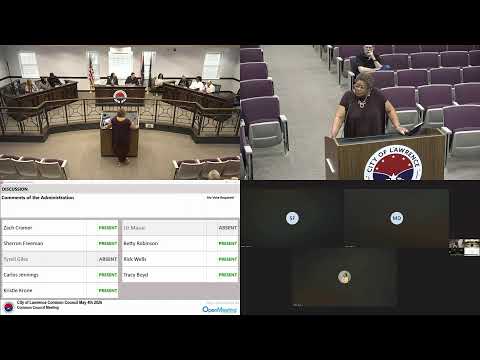
Union representatives at the May 4 Lawrence Common Council meeting presented financial worksheets and proposals tied to a recently negotiated contract that would expand bereavement, holiday rollover and sick‑time accruals for public‑safety personnel.
The unions provided a Baker Tilly report they said was used during negotiations and said it reflected pay‑raise offers the city provided during bargaining. The representatives said the package included a 3% increase for civilian staff and noted that subsequent state law changes (referred to in the meeting as “SEA1”) have complicated the city’s current fiscal picture.
According to union presenters, current bereavement allowances are roughly 24 hours for firefighters and 25.5 hours (three shifts) for police; the unions proposed raising the firefighter benefit to three shifts and police to six shifts while broadening eligible family definitions. Using a high‑service‑year salary proxy, presenters said current per‑incident costs were about $940 for a firefighter and about $1,250 for a police officer, and that the proposed bereavement changes would raise per‑incident costs by roughly $1,900 for a firefighter and about $1,200 for a police officer (figures provided by the unions, subject to city verification).
Union negotiators also proposed raising the holiday rollover cap for post‑2019 hires to 250 hours to give junior employees usable time early in the year, and increasing sick‑time accrual limits (while keeping end‑of‑employment payout limits unchanged) to allow access to hardship leave and other internal programs.
Councilors asked for additional data before acting. "We will try to get what last year's numbers were for police and fire," a union representative said when asked for historical usage counts; councilors also requested a three‑ to five‑year usage trend and a comparison to similarly sized municipalities. Councilor questions focused on total staffing (the unions said the police budgeted for 65 officers and the fire department for 83) and the likely fiscal exposure if accruals and rollovers increase.
Council members also pressed for the administration’s current stance. Union negotiators said the bargaining process had included city representatives (then‑chief of staff Zack Brown, controller Humphrey and outside counsel from Faegre Drinker) and that the contract was signed at the time of negotiation; they acknowledged that the council retains ultimate authority over funding and that subsequent legal or budget changes might alter affordability.
The council did not take a vote on Proposal No. 3 (the ordinance amending public‑safety leave provisions). The chair confirmed the item remains before the public safety committee for further review and that council members expected additional cost detail from city administration and the unions before any final action.
Next steps: committee review with requested follow‑up on past bereavement usage, multi‑year trend data, peer municipal comparisons, and administration cost estimates. The unions agreed to help provide the slide deck and underlying data they presented at the meeting.