Get Full Government Meeting Transcripts, Videos, & Alerts Forever!
Get email alerts on the Education Budget topic
No spam. Unsubscribe anytime.
Millbrook district presents $37.99 million budget, warns cuts if voters reject May 19 levy
Summary
Millbrook Central School District leaders presented the adopted 2026–27 budget — $37,992,751 with a proposed $29,733,237 tax levy — and warned that if voters reject the plan on May 19 the district would face a contingent budget that could force deeper program and staff cuts.
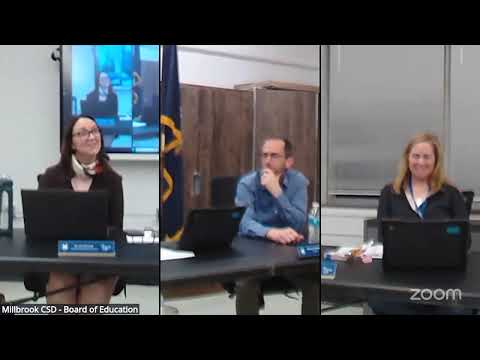
Millbrook Central School District presented its adopted budget for the 2026–27 school year at a public hearing on May 5, laying out a $37,992,751 spending plan and a proposed tax levy of $29,733,237 that would raise the levy by $1,951,101 (7.02%) from this year. District presenters said the numbers include voter‑authorized capital levy proceeds for a previously approved capital project and emphasized that New York State had not finalized its budget as of the hearing, leaving state aid uncertain.
Caroline, who led the presentation, told attendees the district begins budget work in January and refines projections throughout the spring, but that volatile items — especially health insurance and special‑education placements — have pushed costs higher. "Today is May 5th … New York State has issued their ninth budget extender," she said, noting the district must make conservative projections for state aid while continuing to meet student needs.
The administration identified several major cost drivers: a net health‑insurance increase tied to the Dutchess Health Insurance Consortium (presented as roughly $574,000 after negotiations), rising special‑education costs, and transportation and facilities cost pressures. Elliot, the district financial presenter, said special‑education placements and services alone are driving an 8–9% increase in that category and cited examples of how a single family move with multiple high‑need students can add six‑figure costs.
To close earlier budget gaps the district reported reductions totaling about $835,850 — cuts to administrative staffing over recent years, trimmed districtwide professional development, and targeted reductions in athletics supplies and contractual spending — and said it will appropriate an additional $164,000 from fund balance this year while aiming to reduce reliance on reserves over time.
The presentation emphasized the district’s compliance with the state maximum allowable tax‑cap formula even though that formula is not a simple percentage. The administration framed the levy increase as necessary to cover both operating and capital costs — the latter tied to a $61 million voter‑approved renovation program — and warned of the consequences if voters reject the budget at the May 19 vote. If the budget fails, the district said it faces a contingent budget that would require removing “nonordinary contingent expenses” (estimated at about $441,985) and identifying roughly $1.5 million more in cuts to match the previously authorized tax levy, potentially resulting in significant program and staffing reductions.
Administrators highlighted revenue actions that improve the district’s position, including a new early‑college access arrangement with BOCES that shifts tuition costs and is projected to generate an estimated $475,000 in revenue, and expanded facility rental revenues. But they cautioned that many state‑aid line items in the governor’s run may overstate what the district should expect to actually receive.
During public Q&A, community member Lori Maline asked about the district’s device program and whether young children are being issued tablets. The district responded that it does not provide tablets to the youngest learners routinely, described a replacement cycle that allocates devices by grade band, and gave an approximate annual device/replacement budget of $172,000 plus about $25,000 for classroom displays.
Board members and community speakers stressed a desire to protect core programs such as Pre‑K, music, athletics and the early‑college offerings while finding modest savings in supplies and contractual lines. The administration encouraged residents to contact elected officials about state funding and to vote on May 19.
The hearing closed after public comment; the budget remains on the ballot for the May 19 vote. If the budget is approved by voters the district will implement the adopted 2026–27 plan; if not, the board may present a second budget in June or operate under a contingent budget as defined by state law.