Get Full Government Meeting Transcripts, Videos, & Alerts Forever!
Get email alerts on the Presentment Mandamus topic
No spam. Unsubscribe anytime.
State court hears dispute over whether House must present prior legislature's passed bills to the governor
Summary
Attorneys for Michigan's House and Senate argued before the court over whether the House had a legal duty to present bills passed by the prior (102nd) legislature; the dispute centers on mandamus remedies, separation-of-powers limits, and possible conflicts with later laws such as Senate Bill 581 (2025).
The state high court heard competing arguments over whether the Michigan House of Representatives must present bills passed by the prior legislature to the governor, and whether courts may compel that action by writ of mandamus.
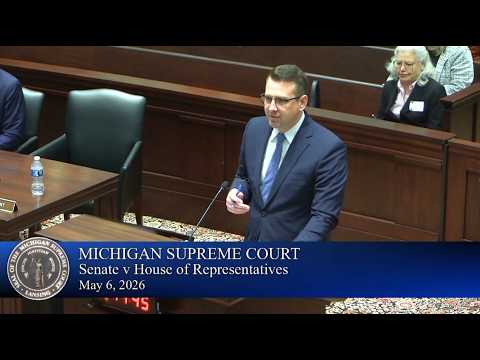
Kyle Asher, counsel for Michigan's 103rd House of Representatives and its clerk, told the justices the judicial branch lacks authority to force a coordinate branch to carry out internal legislative processes and that the House has no clear legal duty to present the prior legislature's leftover bills. "The judicial branch lacks authority to force the legislature to carry out a legislative process," Asher said, arguing that mandamus requires a clear legal duty and that constitutional silence on who must present and when leaves those procedural details to the legislature's own rules.
Asher warned that a ruling compelling presentment in all cases would transfer discretionary choices historically left to the legislature's rules into the judiciary and could disrupt longstanding practices such as vacating enrolled bills. He also raised practical concerns about conflicts with later laws if older bills were resurrected, citing the 2024 History Museum Authorities Act and asking whether presenting older measures could be undone or confused by Senate Bill 581 of 2025.
Mark Brewer, representing the Michigan Senate and the Senate Majority Leader, urged the court to deny the House's application and to allow the bills to be presented to the governor. Brewer said four Court of Appeals judges had unanimously concluded the House had a constitutional duty to present the bills and argued that hundreds of thousands of Michigan public employees, creditors and city residents have been deprived of benefits by the delay. "A constitutional right without a remedy is but a ghost," Brewer said, urging the court to provide a remedy to restore the historical practice.
Brewer pointed to contemporaneous legislative records he said show 19 bills were presented on the morning of Jan. 8 and another 69 presented after the new legislature convened, a pattern he described as consistent with historic practice and the understanding of the Constitution. He argued that the House's refusal to present the contested bills is an extraordinary departure warranting judicial relief and that mandamus could be tailored to direct a nonpartisan officer, such as the clerk, to perform a ministerial presentment if the court concluded a duty exists.
Justices pressed both sides on practical questions: whether recognition of presentment as an enforceable duty would allow a single House leader to veto legislation by withholding presentment, whether courts can or should name a specific official to carry out presentment, and whether mandamus would require a specific deadline or could be effective without one. Counsel for the House stressed remedies and timing raise separation-of-powers concerns; counsel for the Senate emphasized the lack of other remedies and the need to restore the status quo.
The arguments focused on textual readings of Article IV of the state constitution, differing precedents from other states, and whether past unchallenged practices (including instances of post-convening presentment) control the dispute when litigation has now been filed. Neither side sought to downplay institutional consequences: the House argued judicially compelled presentment risks judicial intrusion into legislative process; the Senate argued judicial refusal to provide relief leaves no practical remedy for an asserted constitutional duty.
After rebuttal time and final exchanges over precedent and remedial scope, the case was submitted to the court for decision. The court did not issue an on-the-record ruling at argument.
The court will decide whether the House had a ministerial duty to present the contested bills and, if so, whether mandamus or other relief is appropriate; a ruling could affect the finality of passed legislation, separation-of-powers boundaries, and the implementation timing of measures identified in the briefs.