Get Full Government Meeting Transcripts, Videos, & Alerts Forever!
Get email alerts on the Pesticide Safety topic
No spam. Unsubscribe anytime.
Maine horticulturist: 'The label is the law' — strict PPE, drift limits urged for invasive-plant work
Summary
Gary Fish, Maine State Horticulturist, told invasive-plant managers that following pesticide labels, using appropriate personal protective equipment and minimizing drift are legal and safety essentials; he outlined Maine rules on buffers, permits and posting.
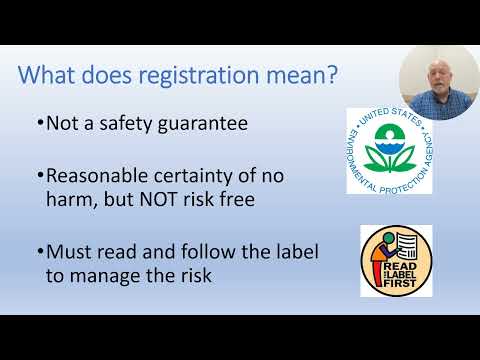
Gary Fish, Maine State Horticulturist at the Department of Agriculture, Conservation and Forestry, told invasive-plant managers during a safety briefing that pesticide labels are legally binding and that following label instructions — including required personal protective equipment — is the first line of defense against acute and chronic harms. “The label is the law,” Fish said, adding that PPE specifications on labels are not optional.
Fish framed risk as a function of toxicity and exposure: “Risk is equal to toxicity times exposure,” he said, and urged managers to choose application methods that reduce exposure, such as stem injection or brush-on cut-surface treatments rather than broadcast spraying.
Why it matters: Fish combined practical protocol with Maine-specific rules to show how applicators can lower human and ecological risks while remaining within regulatory requirements. He warned that EPA-exempt ‘‘25(b)’’ or so-called natural products and many home remedies are often ineffective on established woody invasives and are not risk-free. He also described several legal and procedural limits applicators must follow when treating near people or water.
Key details and regulations: Fish reviewed federal and state registration and testing processes and cited the Food Quality Protection Act of 1996 as a turning point that requires agencies to consider aggregate and cumulative exposures (food, water, household use and other routes) and vulnerable populations. He highlighted Maine rules and label constraints that applicators must follow: - Drift and weather: For powered applications in Maine, applicators must assess sensitive areas within 500 feet and record wind speed and direction; many labels restrict application to winds roughly between 2 and 10 miles per hour and advise avoiding applications at high temperatures to limit volatilization. - Water protections and permits: Fish said treatments that will enter state waters can require a waste-discharge general permit from the Department of Environmental Protection; treating aquatic weeds or emergent vegetation may trigger permitting and reporting requirements. - Shoreland/broadcast limits: Maine generally bars broadcast pesticide applications within 25 feet of the high-water mark (broadcast defined on the recording as applications greater than 100 square feet); spot treatments and variances are possible but require careful planning and, in some cases, Board of Pesticides Control review. - Posting and reentry: Fish noted restricted-entry intervals on labels and said posting is required in many situations (including some agricultural uses). Signs should be conspicuous, include a contact number and are commonly left for 48 hours where required.
Product selection and hazards: Fish explained label “signal words” (caution, warning, danger) and showed examples — citing glyphosate products labeled with "caution" and a 20% acetic-acid product that carries a "danger" signal because of corneal and skin burn risk. He warned that formulation matters: aerosols and dusts pose the greatest inhalation hazards, concentrates and wettable powders carry higher active-ingredient percentages, and granular or ready-to-use products usually present lower inhalation risk.
Glyphosate and classifications: Fish noted that the International Agency for Research on Cancer has listed glyphosate as a probable human carcinogen (Group 2A) but explained that many regulatory agencies evaluate cancer risk at expected exposure levels for applicators and consumers and do not classify glyphosate as carcinogenic at those exposure scenarios.
Exposure-limiting practices: Fish urged applicators to use targeted treatments where possible, wear label-required PPE (gloves, eye protection, long sleeves and pants, head covering when spraying overhead, and waterproof footwear), and follow laundering and hygiene practices to limit take-home exposures. He recommended triple-rinsing containers before disposal and using the Board of Pesticides Control obsolete-pesticide disposal program for unusable products.
Recordkeeping and variances: Fish said some applications near sensitive areas may be allowed through a variance process administered by the Board of Pesticides Control, which requires application paperwork, a written plan (including revegetation where applicable) and a board deliberation and vote.
Resources and next steps: Fish pointed participants to the Board of Pesticides Control and the National Pesticide Information Center for guidance and provided his email and phone number for follow-up questions.
Fish closed by reiterating that adherence to labels, use of appropriate PPE, attention to weather and buffers, and correct disposal are required steps to reduce human and environmental risk and to comply with state and federal rules.