Get Full Government Meeting Transcripts, Videos, & Alerts Forever!
Get email alerts on the Superintendent Transition topic
No spam. Unsubscribe anytime.
Gwinnett County Public Schools introduces Dr. Alexandra Estraa as incoming superintendent
Summary
At a District 4 town hall at Parkview High School, incoming Gwinnett County Public Schools superintendent Dr. Alexandra Estraa laid out a listening‑first agenda, a 100‑day plan and priorities including accelerating classroom learning, equity for students with disabilities and community partnerships.
Gwinnett County Public Schools formally introduced Dr. Alexandra Estraa to District 4 residents at a town hall held at Parkview High School, where she outlined a listening‑centered start to her tenure and immediate priorities for instruction, equity and community partnership.
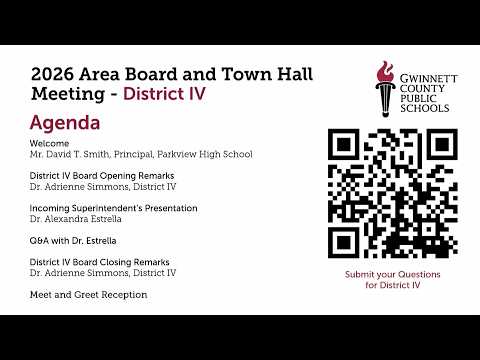
David Smith, principal of Parkview High School, opened the event and said the district "welcome[s] our new superintendent, Dr. Alexandra Estraa," noting her more than 30 years of experience leading large, diverse systems. Student leader Natalie Lopez, president of Parkview's Technology Student Association, introduced Dr. Estraa and highlighted students' confidence in the district's teachers and programs.
Dr. Estraa described herself as "an educator, a leader, a mother, and most importantly, a glamma," and said she will begin officially on July 1 and launch a 100‑day listening and learning tour. "I will be your superintendent and I will launch my first 100 days in which I'm going to engage in a number of listening and learning conversations," she said, adding she intends to use those sessions and data to inform a five‑year strategic plan.
Her stated priorities include accelerating learning by strengthening tier‑one instruction in classrooms and ensuring curriculum materials reflect students' identities so all learners see themselves in the content. She also emphasized preparing students for an evolving workforce, noting the growing importance of AI competency: "the field already prefers to hire someone without experience but with AI competency," she said, arguing that schools must adapt instruction accordingly.
Estraa highlighted inclusion and special education as central to her approach, calling special education "a service, not a permanent placement," and advocating program designs that allow students receiving services to access the same curricular expectations as their peers with appropriate scaffolds. She said her prior work raised graduation rates and reduced chronic absenteeism, citing a previous district's 93% graduation rate as an example of expected outcomes from targeted program and instructional changes.
The town hall format combined a student‑moderated conversation with community‑submitted questions via a QR tool; topics raised by residents included financial transparency, classroom screen time, teacher preparation and redistricting. The board closed by directing attendees to a QR link with details about a multi‑year redistricting process and invited the public to a meet‑and‑greet with Dr. Estraa.
The district did not take formal board action at the event; Estraa's remarks laid out priorities and next steps: listening sessions, staff engagement and data reviews that will inform any future proposals or policy changes.