Get Full Government Meeting Transcripts, Videos, & Alerts Forever!
Get email alerts on the Sales Tax Exemptions topic
No spam. Unsubscribe anytime.
Tennessee Department of Revenue webinar reviews common sales tax exemptions and TNTAP registration
Summary
Department of Revenue staff walked businesses and nonprofits through how to apply for common sales-and-use tax exemptions, demonstrated the TNTAP portal, and explained key eligibility rules for resale, agricultural, industrial machinery, nonprofit, government and common-carrier exemptions.
Jeremy Cain, of Taxpayer Education with the Tennessee Department of Revenue, hosted a webinar that walked businesses, accountants and nonprofits through the state’s most commonly used sales-and-use tax exemptions and how to apply for them through the TNTAP online portal.
The session covered six primary exemption categories and step-by-step registration. Cain said the certificate of resale "is automatically issued when you register a sales and use tax account," and stressed that resale certificates apply only to purchases intended for resale and must be maintained separately for each business location. Billy Trout, also with Taxpayer Education, advised sellers and vendors to request recent copies of certificates when necessary and urged electronic filing through TNTAP to speed processing.
Martha Potter, a subject-matter expert in Taxpayer Services, detailed agricultural exemptions and documentation. She said farmers, timber harvesters and nursery operators who sell at least $1,500 in agricultural products in a year (or who can produce Schedule F/receipts) may qualify, and that an agricultural certificate is valid for four years and must be renewed when details change. Potter emphasized the "more-than-50%" primary-use test: tangible personal property must be used primarily (over 50%) in agricultural operations to qualify.
On industrial machinery, Cain and Potter explained the exemption is aimed at qualified manufacturers and processors. Qualifying machinery, parts and repair components used in fabrication or processing for resale are eligible if the location’s gross receipts are primarily from fabrication or processing; contractors installing machinery must apply separately and provide project contracts and dates. Potter advised that projects tied to public works (for example, water/wastewater treatment) require contract documentation for authorization.
The presenters clarified how nonprofit and government exemptions work. Nonprofit exemptions (501(c)(3) and other qualifying entities) apply to purchases paid with the organization’s funds, not to sales conducted by the nonprofit (those sales may be taxable). Nonprofit certificates renew every four years; out-of-state IRS exemption letters may be used by qualifying out-of-state 501(c)(3) organizations. Government exemptions apply to Tennessee state, county and municipal agencies and to federal agencies and government-owned schools; the department does not accept out-of-state government exemptions.
For common carriers, Cain said vehicles must generally be IRP-registered or have federal authority and typically meet GVWR class 03 (16,000 pounds) or higher; certain trailers and freight equipment may be exempt when they meet motor-vehicle exemption requirements.
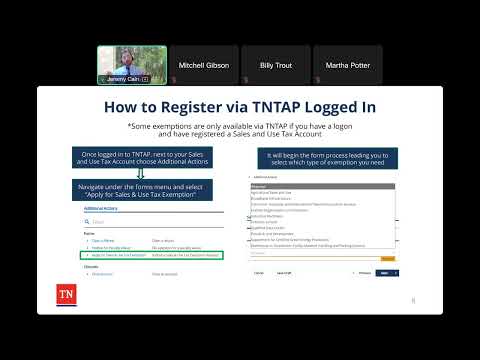
Speakers demonstrated the TNTAP workflow for both unauthenticated and signed-in users and pointed attendees to detailed guides and on-screen forms on TN.gov/revenue. Cain noted that some exemptions require an active sales-and-use tax account before application and showed where applicants can upload supporting documents (for example, proof of government payments, Form 1099, Schedule F or the date the land was acquired).
Attendees were directed to submit technical transaction questions through the department’s Zendesk portal for researched answers, and the presenters provided contact points for general support (revenue.support@TN.gov) and phone assistance (615-253-0600 general line; 615-253-0601 exemptions line). The webinar closed with an announcement of an upcoming webinar, and a reminder to complete the post-event survey to receive continuing professional education credit.