Get Full Government Meeting Transcripts, Videos, & Alerts Forever!
Get email alerts on the Library Funding topic
No spam. Unsubscribe anytime.
Rhinebeck board approves $72,000 loan to Star Library after heated debate over voter-approved increase
Summary
After a contentious public exchange and legal briefing on New York Education Law §259, the Rhinebeck Town Board voted to lend Star Library $72,000 while reserving contract terms and repayment conditions; the board split over whether to forgive $20,000 as part of a compromise.
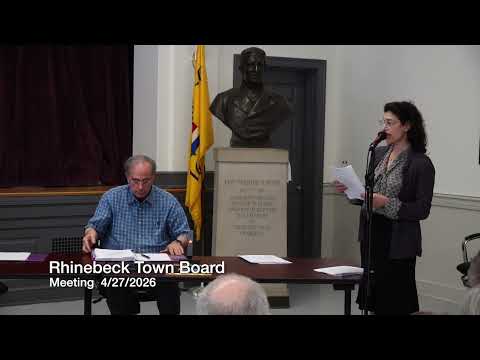
RHINEBECK, N.Y. — The Rhinebeck Town Board voted April 27 to lend Star Library $72,000 to cover a budget shortfall tied to a voter-approved library levy increase, ending a contentious meeting in which the library director warned the board’s interpretation of state law could set a “dangerous” precedent for libraries statewide.
Town attorney Michael told the board the issue stems from the interaction between New York Education Law §259’s 414-proposition process and town budget deadlines: an increase approved by voters does not apply retroactively to a municipal budget adopted before the election. That legal interpretation underpinned the board’s reluctance to simply apply the voters’ approved amount to the town’s adopted 2026 budget.
Jacqueline, director of Star Library, disputed that the library or town had followed the process improperly and urged the board to find a solution that avoided service cuts. “There’s a war against libraries happening all over this state and country,” Jacqueline said, arguing that using Education Law §259 as a reason not to provide the voted increase would be “handing a roadmap for obstruction” to less friendly municipalities.
Andrew Shulkin, a Star Library trustee and the acting president of the board of trustees, criticized shifting proposals from the town and warned that the library’s endowment is not an unrestricted operating fund. “It’s the third time that a proposal was changed without comment, without explanation,” Shulkin said, describing a sequence of offers that moved from grant to loan with changing terms.
Board members debated alternatives including a loan with partial forgiveness, a full grant, and asking the library to pursue a 414 proposition to recover funds in subsequent years. One amendment — to forgive $20,000 of the $72,000 contingent on the library submitting a formal budget request and following through on recovery steps — failed on the floor. A separate motion to lend $72,000 at 0% interest over several years passed, recorded as carrying with three affirmative votes and two negatives.
The loan resolution specifies that the loan is “subject to signing a contract with the terms,” and board members said they expect town counsel and the library’s counsel to draft and review that contract. Several board members emphasized the town’s limited flexibility under a 2% tax cap and the need to protect general-fund obligations, while library trustees said dipping into endowment funds would harm long-term operations.
Several trustees and former trustees urged the board to delay a final vote and negotiate terms; one former trustee, David LaValley, asked the board to take more time to meet with library leadership. The board instead voted on the loan resolution and approved it that night.
The board also discussed possible procedural fixes for future years, including clearer written notices during the budget window and a commitment to coordinate more closely with the library during budget preparation. Town officials said they will collaborate on contract terms and bring a draft agreement forward for review.
The board adjourned the meeting and said it would meet in an attorney-client executive session after adjournment.
What happens next: The approved loan requires a written contract; board members said they will draft the contract with town counsel and expect a follow-up on terms and timelines before funds are distributed.