Get Full Government Meeting Transcripts, Videos, & Alerts Forever!
Get email alerts on the School Budget topic
No spam. Unsubscribe anytime.
Rochester school board delays final budget vote to May 12, demands focused updates on pre-K, special education and social supports
Summary
After a second deliberation, the Rochester City School District Board of Education moved its tentative May 5 budget vote to May 12 and asked the superintendent for concise updates on pre‑K placements, special education staffing and social‑emotional supports before finalizing a vote.
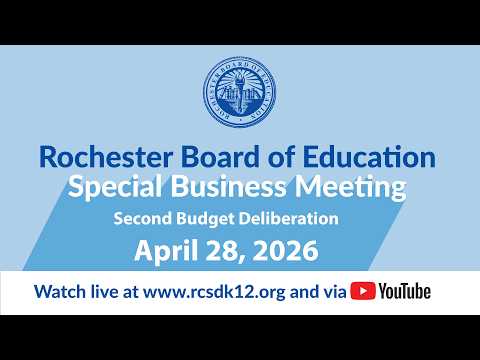
The Rochester City School District Board of Education on April 28 voted to move its final budget vote from May 5 to May 12 and instructed the district administration to provide concise, targeted updates on several priority areas before the next meeting.
"When the numbers came in, we were at about a $49 million gap. And through the work of finding efficiencies ... we were able to bring that gap down to 23 million," President Simmons said as she opened the board's second deliberation on the draft budget. Her remarks framed repeated commissioner concerns about program cuts and proposed program moves across the district.
Commissioners used the session to name the issues they want administration to address before a final vote: planned moves of pre‑K sections and the creation of two new pre‑K centers; the number and placement of social workers and school counselors; the district's home‑hospital instruction model; special education staffing and methodology; community schools and parent centers; nutrition programs; athletics and CTE/CPPS offerings; and the My Brother's Keeper initiative.
"I have a question with the athletics not being part of this budget as they are in the past," Commissioner Griffin said, adding that athletics can play a role in student retention and social‑emotional supports. Several other commissioners raised similar points about pre‑K and special education.
Superintendent Dr. Rossiter told the board the draft provided to commissioners remains incomplete while the district awaits state aid and federal allocations. He said the administration would deliver an updated draft the following morning and prepare an executive summary highlighting substantive changes.
"We received a million dollars in philanthropic support, almost a million dollars in philanthropic support. We received 3.5 million dollars in school improvement grant funds. And we also received notification that this upcoming year ' will be no different than former years, where each of our receivership schools will receive $200,000 each for a total of an additional 1.4 million dollars," Dr. Rossiter said. He told commissioners some adjustments already made after April 7 are not reflected in the printed draft.
Board legal counsel cautioned members that the budget is legally the board's responsibility and that if the board declines to adopt a budget, it must produce an alternative. "If the board does not pass a budget, the board has to come up with its own budget," Council Neil said, advising that there are significant practical and legal consequences to failing to adopt a plan.
Faced with the list of concerns and limited time, Commissioner LeBron asked colleagues to put their top "do's and don'ts" in writing and proposed delaying the vote to allow administration time to respond. Commissioner Griffin moved to change the budget vote date; the motion was seconded by Vice President Malloy. After discussion the board set the final vote for May 12.
The board also voted to convert May 5 from a vote to a deliberation to allow further engagement and directed each commissioner to submit three to four priority items in writing to Board Clerk Rahima by 12:00 noon the next day to help administration prioritize brief presentations and written clarifications.
To keep follow‑up concise, the administration proposed delivering short, high‑level updates focused on the named priorities (three to five slides, roughly 10–15 minutes each), spread across the upcoming deliberations. Commissioners agreed to meet at 4:00 p.m. on the next Thursday for the first set of follow‑up items and to continue deliberations as needed before the May 12 vote.
The session underscored the tight fiscal picture: President Simmons and several commissioners referenced a multiyear projection the state monitor presented last year, which the board said showed much larger gaps if structural changes are not made. Commissioners repeatedly emphasized the tradeoffs involved in restoring programs such as social workers or home‑hospital staff, noting that any restorations will likely require cuts elsewhere unless new state aid or other revenue materializes.
The board adjourned after confirming the schedule and submission deadline for priorities. The administration will deliver an updated draft budget to commissioners the next morning and is expected to provide targeted materials and brief presentations at the 4:00 p.m. Thursday meeting.