Get Full Government Meeting Transcripts, Videos, & Alerts Forever!
Get email alerts on the Income Tax Policy topic
No spam. Unsubscribe anytime.
Committee backs alternative progressive income tax, recommends eliminating I‑Tax for FY27 and preserving Working Families supplement
Summary
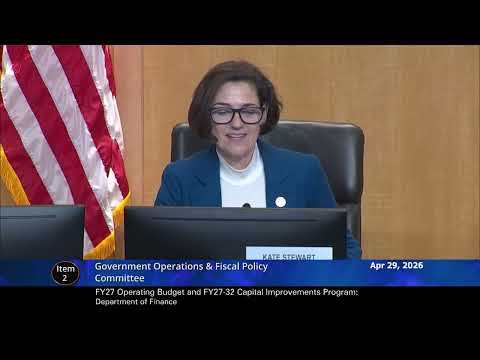
The Montgomery County Government Operations and Fiscal Policy Committee voted to send an alternative progressive income-tax plan to full council, signaled opposition to the county executive’s proposed property-tax increase, recommended setting the income tax offset credit (I‑Tax) to $0 for FY27 with one‑time proceeds directed to capital projects, and kept the Working Families Income Supplement at the current 56% match.
The Government Operations and Fiscal Policy Committee recommended this week that the full Montgomery County Council consider an alternative progressive income-tax structure that would preserve most current benefits for low- and middle-income filers while applying the county’s top marginal 3.3% rate only to higher income slices.
In a lengthy staff briefing, committee members and finance staff laid out the tradeoffs of a switch from the current flat county income tax to progressivity. Staff warned that a progressive structure reduces revenue compared with a flat 3.2% rate because lower marginal rates on the bottom of the distribution cut into the broad base; their modeling showed a multi‑year revenue delta on the order of roughly $190–$200 million under one progressive scenario. The committee ultimately favored an alternative that begins taxing income segments above $150,000 at the top marginal rate to narrow that gap.
Why it mattered: the county’s income-tax change would affect all filers and will phase in over several fiscal years. Staff emphasized that a tax‑year change takes effect Jan. 1, 2027 at the earliest and that the full revenue impacts appear over multiple fiscal years as filings and withholding patterns adjust. Finance staff told the committee the top 4% of filers currently contribute roughly 36.1% of county income‑tax revenue.
What the committee decided: after discussion, the committee voted to send the alternative progressive structure to the full council for consideration rather than endorsing the county executive’s proposed flat increase to 3.3% for every filer or retaining 3.2% status quo. Committee leaders said they preferred an approach that reduces taxes on lower‑income filers while limiting revenue loss by preserving higher marginal rates for high‑income filers.
I‑Tax and one‑time funding: the committee also debated the long‑standing income tax offset credit (I‑Tax), a property‑related credit limited to owner‑occupied units that requires the homestead filing. Staff estimated about 202,000 owner‑occupied households would receive the I‑Tax in FY27 at the executive’s $692 level, and said eliminating the credit for FY27 would free roughly $139.7 million in one‑time resources (the program functions like a $139.7M line in budget terms because it reduces county revenues).
The committee’s working consensus was to recommend setting the I‑Tax to $0 for FY27 and directing the one‑time savings toward capital improvement needs (paygo for the CIP), rather than using the funds for recurring operating expenses. Chair Stewart framed the move as a one‑time source to reduce borrowing needs and target deferred capital needs; staff warned any I‑Tax change would be one‑time for FY27 and must not be treated as an ongoing operating revenue source.
Working Families Income Supplement: committee members unanimously opposed eliminating the county match to the state Earned Income Tax Credit (the Working Families Income Supplement). Staff described the county supplement as a proven anti‑poverty tool, noting it reaches lower‑income households — including some who file with ITINs — and is uncommon at the local level. The committee opted to keep the match at the current 56% level; the budget includes $1.7 million assumed for state billing and separate reconciliation items were discussed but not advanced to eliminate the supplement.
Next steps: the committee’s recommendations — the alternative progressive proposal, the I‑Tax reduction to $0 for FY27 with one‑time funds to CIP, and keeping the WFI match at 56% — will be transmitted to the full council for final votes. The property‑tax rate and related items will appear on the council’s separate levy resolution as required by state advertisement and hearing rules.
Representative quote: County staff summarized the progressive tradeoff: “A progressive income tax structure means we will not make as much revenue in the county as we used to under the flat rate because there's too much area under that flat rate that we are losing,” and the committee’s chair added the committee preferred an alternative that narrowed the revenue gap while protecting low‑income households.
The meeting adjourned with the committee scheduling further review at the full council.