Get Full Government Meeting Transcripts, Videos, & Alerts Forever!
Get email alerts on the Capital Improvements topic
No spam. Unsubscribe anytime.
Oxnard committee shifts CIP priorities, asks staff to bring revised Category 4 to council
Summary
After lengthy discussion of paving, Campus Park, generator reliability and Performing Arts Center seismic needs, the committee voted 3–0 to have staff produce a reprioritized Category 4 CIP list—moving several safety and park projects ahead of some arterial resurfacing—and forward that list to the full council with the public hearing and budget timetable.
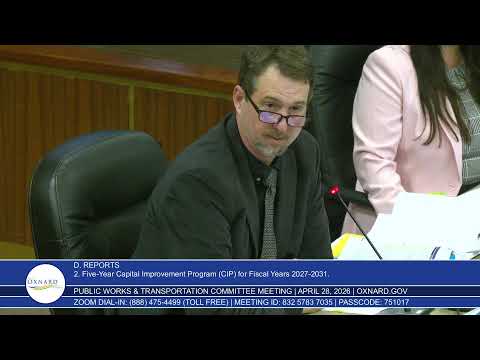
The Public Works & Transportation Committee spent the bulk of its April 28 meeting reviewing the draft 2027–2031 Capital Improvement Program and directed staff to return to council with a reprioritized Category 4 list that elevates selected safety and park projects ahead of some arterial paving work.
Director Michael Wolf framed the meeting as a prioritization exercise rather than a conversation about final dollar amounts. "The conversation tonight is do we get the prioritization correct?" he told the committee, explaining the staff approach to categorizing projects into existing funded projects (Category 1), lower-urgency existing projects (Category 2), new projects with dedicated funding (Category 3), and projects that compete for general fund/Measure O resources (Category 4).
Committee members repeatedly raised health-and-safety priorities. Councilmember Basua flagged two generator projects (10A annex generator and 18A civic-center/annex feed) and fire-station overhead doors as top priorities; staff said one generator is currently out of air-quality compliance and that options include replacement, retrofit or temporary portable equipment. Members also pressed for funding to complete Campus Park Phase 3 (item 8A), noting a $433,000 local gap for non-grant-eligible elements such as a dog park, and pressed staff on the Oxnard Performing Arts Center seismic retrofit (item 19A), which staff estimated in rough order of magnitude at about $20 million total (roughly $2 million for design and larger sums for construction in subsequent years).
Staff described the pavement-management program (items 1A–4A) and explained the city's PCI stands at 67 with a council target of 70; maintaining or improving that score typically requires roughly $20–23 million per year in pavement investment, staff said. Committee members acknowledged the long-term cost advantages of maintaining pavement early but proposed elevating several projects above some arterial preventive-maintenance work, including generators, stormwater-conveyance repairs that have compromised private property foundations (Sutter Drive/Diamond Bar area), PD parking-lot repairs, bridge maintenance and select park infrastructure (restrooms, shade structures and bleacher replacements).
Public speakers representing downtown and parks urged attention to the Carnegie Art Museum and Oxnard Boulevard lighting and median improvements; the Downtown Oxnard Improvement Association said the city's cultural-district designation increases the urgency of gateway investments.
After discussion, Chair MacArthur moved—and the committee seconded—direction to staff to produce a reprioritized Category 4 CIP spreadsheet reflecting the committee's recommendations and to bring that list to the full City Council along with the required public hearing and the upcoming operating-budget timetable. The motion carried 3–0.
Staff said they will retain the original Category 4 list as a benchmark and return a reprioritized version so council can compare the two lists when making final funding decisions.