Get Full Government Meeting Transcripts, Videos, & Alerts Forever!
Get email alerts on the Land Use Development topic
No spam. Unsubscribe anytime.
Planning commission approves Raising Canes drive‑through at Delta Shores, upholds 10 p.m. drive‑through limit
Summary
The Sacramento Planning and Design Commission approved a conditional use permit for a Raising Canes drive‑through at Delta Shores but adopted staff’s recommendation to limit drive‑through hours to the city’s 10 p.m. cutoff because the site backs up to single‑family yards. Commissioner Goris recused; vote passed among present commissioners.
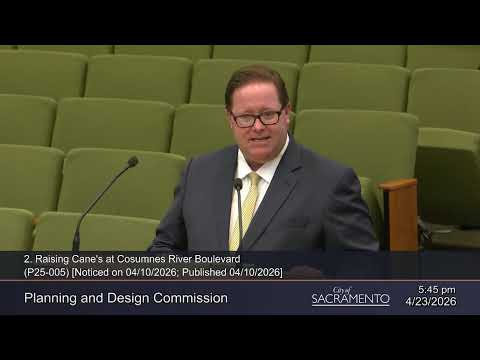
The Sacramento Planning and Design Commission on April 23 approved a conditional use permit and site plan for a Raising Canes drive‑through at Delta Shores but upheld the city’s 10 p.m. limit on drive‑through operation when adjacent to single‑family homes.
Planner Danny Abbis told commissioners the project would sit next to private yards with homes about 15 feet from the property line, and staff recommended upholding the 10 p.m. regulation to protect nearby residences from late‑night noise and other nuisance impacts. Abbis said staff had received letters and direct comments from four immediately adjacent homeowners who raised concerns about late‑night disturbance and lighting.
Ryan Hooper of Thatch and Hooper, speaking for the applicant team, said Raising Canes and its consultants made multiple design changes after neighbor outreach: denser and taller landscaping along the east and south property lines, elimination of speakers on the east side, downward‑shielded lighting, and an automatic voice control (AVC) ordering board intended to reduce loudspeaker volume. Hooper said a supplemental noise analysis by Kimley Horn showed the combined measures could reduce impacts “up to 12 dB” and that the project would be below the city’s maximum noise standards.
“I think we take the neighbors’ concerns very seriously,” Hooper said, while also warning that a strict 10 p.m. drive‑through closure could make the site infeasible compared with adjacent competitors. He said the applicant originally sought a 3:30 a.m. closing and later offered a compromise of 1 a.m. on weekdays and 1:30 a.m. on weekends; at the hearing he told commissioners the company would consider a midnight cutoff if necessary to gain approval.
Noise consultant Alex Juwel described the assessment method to the commission and said the ambient level at the eastern property line measured about 55 dB. “In all cases for the project operations the project would be below not only the city’s noise ordinance limits but also below the existing ambient noise level,” he said.
Neighbors disputed the characterization of impacts. One nearby resident who said he lives directly behind the proposed parcel told the commission the development is “fundamentally incompatible with the surrounding neighborhood,” citing light, cooking odors and late‑night noise that would disrupt sleep and lower property values. Another opponent said if the project truly met city standards it would not be seeking a time modification.
Commissioners debated differences between this proposal and a prior approval the commission referenced (which involved multifamily setbacks of roughly 200 feet). Several members emphasized the distinction that those previous approvals did not back immediately onto single‑family backyard yards as this site does.
Commissioner Lee moved to approve staff’s recommendation (including the 10 p.m. drive‑through cutoff); Vice Chair Kaden seconded. Commissioner Jose Goris had recused himself before discussion because of prior community conversations; two commissioners were absent. The motion passed with the commissioners present voting yes.
Next steps: the commission’s approval authorizes the conditional use permit and site plan/design review subject to the project conditions imposed by staff; the commission record shows the drive‑through hours will be limited consistent with the city’s rule for drive‑throughs adjacent to single‑family residences.