Get Full Government Meeting Transcripts, Videos, & Alerts Forever!
Get email alerts on the Bylaws And Agenda Redesign topic
No spam. Unsubscribe anytime.
Ad hoc committee backs sending revised bylaws to full board after changes to committee structure and public-comment rules
Summary
An ad hoc bylaws and agenda redesign committee reviewed edits to replace mandatory 'shall' language, clarified standing-committee composition (including CTE and health/behavioral-health committees), tightened public-comment sign-up and time limits, and voted to forward the revised bylaws to the full board.
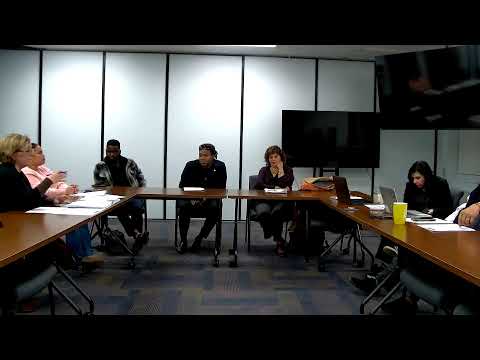
Terrell Stevens called the ad hoc bylaws and agenda redesign meeting to order and the committee moved, discussed and approved forwarding the revised bylaws to the full school board for final approval.
The committee spent the session reviewing a redlined draft. Members discussed a general stylistic change — replacing many instances of the mandatory word "shall" with the discretionary "may" — and flagged several sections requiring clearer role-based language. Sarah, who reviewed the integrated draft and annotated murky passages for the group, recommended using "select committees" rather than "special committees" to avoid confusion with the text that defines "special meetings." The committee agreed to that change in principle.
A central focus was committee composition. Members debated whether some standing committees should be exclusively board-led (the group repeatedly cited finance and policy as candidates for board-only membership) or should include a designated administrative presence to provide continuity and material needed for recommendations. The legal/technical issue of quorums and the Open Meetings Act surfaced repeatedly; counsel advised caution, noting informal or unscripted board comments can create OMA risks, and the committee removed an open "board comments" placeholder to preserve a scripted agenda format.
On program-specific committees, the committee endorsed these working limits: an "up to nine" membership cap for the Career and Technical Education (CTE) committee (with no fewer than two and no more than three board members and designated administrative representation), and a capped health-and-wellness committee sized to allow a majority of non-school employees (the draft uses a maximum of 15 with the statutory requirement that a majority be non-school employees). The group also discussed a newly required student safety and behavioral-health committee created by recent legislation and agreed to keep role-based membership language so the board can meet statutory composition requirements.
Public-comment procedures drew lengthy discussion. The draft language presented to the committee would: require sign-up (electronic or in person) by 4:00 p.m. the day before the meeting while preserving a 30-minute walk-up sign-up window immediately before the meeting; allot up to two minutes per speaker; cap total public comment at 30 minutes with the board empowered to extend that cap by majority vote; prioritize parents, students and guardians for speaking order; and encourage (but not require) a brief topic description to allow staff to follow up. The committee also discussed options for handling very large turnouts — including postponing public comment to a special meeting focused on the item — and agreed to include "best efforts" language for bringing district staff to meetings when feasible.
On conduct, the committee agreed to prohibit public commenters from making disclosures about other students and to recommend that personnel complaints be directed to the superintendent’s office or the family-engagement team rather than aired in public comment. Legal counsel emphasized the need to avoid provisions that could be read as impermissibly limiting protected speech, and the draft reflects that balance by discouraging—but not criminalizing—certain forms of personal attacks.
At the end of the meeting, the committee approved a motion to forward the revised bylaws to the full board as amended. The vote was taken by voice and the chair declared the motion passed; a roll-call tally was not stated in the transcript. The committee then moved to adjourn and recording was stopped on request.
What happens next: the revised bylaws will be transmitted to the full board for consideration at its next regular meeting. The ad hoc committee redlines will accompany that packet so full-board members have the final recommended language and the committee’s notes on statutory compliance.