Get Full Government Meeting Transcripts, Videos, & Alerts Forever!
Get email alerts on the Infrastructure topic
No spam. Unsubscribe anytime.
Lane County authorizes emergency procurement to stabilize Currin and Stewart covered bridges
Summary
The Board approved emergency procurement authorization and delegated signature authority to stabilize the Currin and Stewart covered bridges, citing structural instability and public‑safety risk; staff estimated stabilization ranges of roughly $228,000–$409,000 per bridge and said the work aims to buy 10–20 years of service.
The Lane County Board of Commissioners on April 28 authorized emergency procurement to stabilize two historic covered bridges in the Cottage Grove area — the Currin and the Stewart covered bridges — and delegated the County Administrator authority to sign the emergency procurement exemption form.
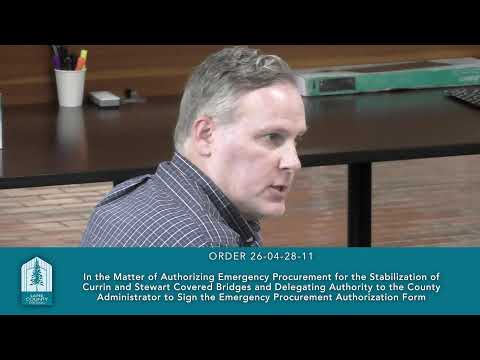
Brett Harris presented the request, saying the bridges have been taken offline for regular use but remain heavily visited and are in “really dire shape,” creating a safety risk. Harris said the request follows a prior board order authorizing transient lodging tax (TLT) reserves for stabilization and that the emergency procurement is requested under Lane Manual procurement policy to allow prompt work to protect public safety and county assets. Harris noted coordination with the State Historic Preservation Office (SHPO) will be required for any work that alters historic fabric and that the immediate request is for temporary stabilization — not full rehabilitation or replacement.
Staff cited consultant cost ranges for temporary stabilization: Stewart approximately $228,000–$371,000 and Currin approximately $252,000–$409,000, which would cover engineering and related services. Staff emphasized these are ranges provided by the county’s engineering consultant and final costs will depend on accepted proposals; staff also said stabilization is intended to buy time and could extend the useful life of repairs for roughly 10–20 years depending on scope and roof work.
Commissioners asked about community outreach and long‑term stewardship. Commissioner Fregger said the Cottage Grove Chamber and community support preserving the bridges but staff reported no local nonprofit has yet agreed to take long‑term stewardship. Commissioner Moore asked where funds beyond the $500,000 TLT allocation would come from if needed; staff identified potential county capital funds (parks SDC fees/fund 266), covered‑bridges subfunds, the parks levy (fund 295) only after bids are known, and other internal or external sources, and said the board would be returned to if costs substantially exceed estimates. Commissioners also noted that decommissioning and removal remain an option but that preliminary consultant advice suggested demolition costs would likely exceed stabilization and would carry permitting and SHPO coordination challenges.
Commissioner Lovell said the 15‑year minimum life the consultant estimated for targeted stabilization convinced her the effort was worthwhile because it buys time for community planning. The board approved the emergency procurement authorization and delegation by recorded vote, recorded as 4‑0 with Commissioner Farr excused absent.
What the action does: authorization allows the county administrator to execute an emergency procurement exemption and proceed to engage engineering and qualified contractors to design and install temporary stabilization measures (which may include cofferdams, scaffolding and steel bracing) during the 2026 construction window.
Next steps: staff will initiate procurement, evaluate proposals, return to the board if costs exceed current budget authorization, and coordinate required permitting and SHPO consultation.