Get Full Government Meeting Transcripts, Videos, & Alerts Forever!
Get email alerts on the Literacy Curriculum topic
No spam. Unsubscribe anytime.
Carmel Clay Schools demonstrates 'science of reading' approach in middle‑school workshop
Summary
District leaders demonstrated a middle‑school lesson aligned to the science of reading, saying the K–8 shift to knowledge‑based curricula and explicit vocabulary, fluency and writing‑to‑read practices will build coherence and prevent reading failure.
Dr. Dudley told the Carmel Clay Schools board that the district is extending a research‑based ‘‘science of reading’' approach into middle school classrooms and that the work is now expected by state guidance for grades K–8.
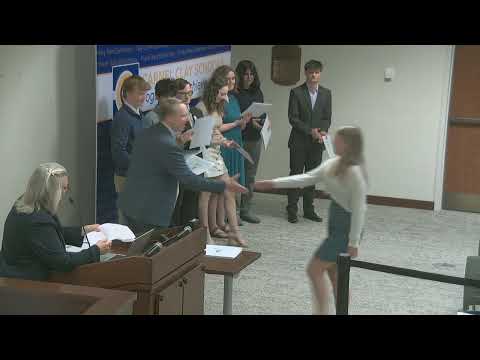
Mrs. Aurorio and three middle‑school teachers led a classroom demonstration that used an adapted Amplify ELA lesson. The presenters asked board members to practice the lesson's elements—background knowledge building, explicit vocabulary instruction, close reading and writing‑to‑read—then observed eighth‑grade students modeling the activities. "We are doing this work regardless," Dr. Dudley said, describing the goal of making complex text central to instruction rather than treating texts as secondary to skills practice.
The presenters emphasized two instructional priorities: providing systematic background knowledge and daily explicit vocabulary instruction, and keeping complex text at the center of lesson design so students engage with demanding language in class with teacher support. In the demonstration, teachers led a multi‑read close reading of an excerpt of Rald Dahl's Boy Tales of Childhood, asked students to annotate details about a character, and then rehearsed how those details support a written claim about the character.
Teachers stressed that fluency work and decoding instruction must continue beyond elementary grades and described tiered supports for students who arrive underprepared. "Good instruction is preventative," Mrs. Castler said during the Q&A, arguing that strong Tier‑1 instruction in the classroom reduces downstream reading failures and narrows gaps. Presenters said the district supplements core instruction with focused morphology and multisyllabic decoding work during Core‑Plus time for students who need additional practice.
Dr. Dudley tied the lesson to statewide guidance and the district's materials choices: the district has piloted and is moving to more coherent K–8 programming (including Amplify) to align instruction across grades. "The first place for prevention or the first form of intervention is right in the Tier‑1 classroom," she said, noting that coherent curriculum and intentional instruction are central to the plan.
Board members asked how late‑arriving students or students from different schooling backgrounds are identified and supported. Presenters replied that diagnostic work to determine which strand of Scarborough's reading rope (word recognition versus language comprehension) a student is missing drives targeted interventions; brief, evidence‑based decoding and morphology modules have produced measurable gains when combined with additional instructional dosage.
The workshop concluded with a request for continued district‑level supports for classroom implementation, professional development and time for teachers to plan together so the curriculum's "intention and intensity" are consistent across schools. The session closed with board applause for the student participants and the teaching teams.