Get Full Government Meeting Transcripts, Videos, & Alerts Forever!
Get email alerts on the Public Health Budget topic
No spam. Unsubscribe anytime.
McHenry County health officials defend services as grants cover much of staff costs ahead of tight county budget
Summary
Public Health Administrator Melissa Adamson told the county committee that the McHenry County Department of Health delivered hundreds of thousands of inspections, vaccinations and direct services last year but that roughly 40 positions are partially or fully grant-funded and the department relies heavily on non-property-tax revenue as the county faces budget pressure.
McHenry County's Public Health Administrator, Melissa Adamson, told the Public Health and Community Services Committee on April 30 that the department provided a broad slate of mandated services and that the FY25 budget stood at $8.151 million.
Adamson said the department employs about 121 full-time equivalent staff and that roughly 60% of its revenue comes from fees, grants and miscellaneous sources, leaving the general fund to cover about 39.6% of costs. "This is our financials for fiscal year 25. Again, the budget was 8.151 million," she said, and later added that "roughly a little over 40 positions are partially or fully covered by grants."
Why it matters: Committee members pressed staff for clearer, program-level accounting because many programs rely on time-limited grants. Several board members warned that losing grant funding could force program reductions or shift costs to property taxpayers during an already tight county budget cycle.
The department outlined core services and workload metrics to illustrate that spending supports high-volume public protections: Adamson reported nearly 16,000 compliance and surveillance activities and nearly 12,000 consultations in the year covered, along with thousands of restaurant and beach inspections, private well reviews and vector control activities.
On public-health programs, the nursing division described the Illinois Breast and Cervical Cancer Program (IBCCP) and recent state funding increases. "We got 18,000 additional dollars," a nursing director said, and staff said the department coordinates diagnostic appointments with Gaver's Cancer Center to speed care for underinsured patients.
Presenters also described communicable-disease work and the epidemiology team. The department explained how outbreak investigations are triggered (often small clusters, depending on the illness), how environmental health and Epi coordinate with hospitals and schools, and why investigations can be time-intensive.
Community-health programs highlighted partnerships and outreach. Megan, the director of community health, described Operation Drop Box, a countywide preparedness/donation drive that now uses 109 collection sites and funnels donations to the Veterans Path to Hope Center. The department also detailed an opioid-surveillance process that triggers targeted local responses and naloxone distribution when overdose clusters are detected.
Budget implications and next steps: Committee members repeatedly asked for a ledger-style breakout that shows, by program and position, what is grant-funded and what comes from the general fund. Adamson said the department regularly works with grantors to reallocate funds for personnel when permissible and that monthly Board of Health financial packets already provide division-level details; she offered to send committee members the most recent packet and to prepare clearer, program-by-program information for forthcoming budget deliberations.
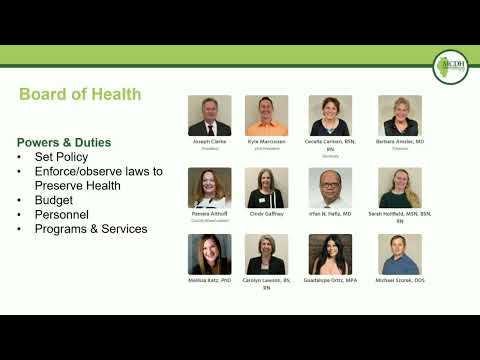
The Board of Health has directed staff to review modest user-fee increases to help offset operating costs; Adamson said those proposals will go to the Board of Health and then to the county. A committee member summarized the tradeoff: "From the general fund, there's approximately 40% of our revenue paid by the property taxpayers," the member said, urging colleagues to consider grant reliance when setting priorities.
The department invited the full county board to a future presentation on pandemic-preparedness, emergency coordination with the county Emergency Management Agency, and other program highlights.
What happens next: The committee asked for historical grant-trend comparisons and a clearer breakdown of personnel costs tied to grants; staff agreed to provide those materials in advance of the county budget cycle.