Get Full Government Meeting Transcripts, Videos, & Alerts Forever!
Get email alerts on the Town Center Plan topic
No spam. Unsubscribe anytime.
Town Center plan stirs debate over parking, safety and the future of Robert's Market
Summary
Good City consultants presented draft concepts for Woodside’s Town Center Area Plan. The meeting centered on circulation, a north‑side multi‑use path, and competing proposals for the Kinyatta–Woodside–Mountain Home intersection; business owners of Robert's Market strongly opposed removing or relocating front‑door parking, prompting council direction to workshop revisions that preserve parking and seek business buy‑in.
The council hosted a major workshop on the Town Center Area Plan led by Good City consultants Troy and Ryan. After a year of outreach (pop‑ups, a survey with more than 500 responses, three CAC meetings and a workshop), the consultants presented policy objectives—preserving Woodside’s rural and equestrian character, improving safety and pedestrian access, enabling modest additional public spaces and supporting local businesses—and four topic areas: transportation, parking, land use and public space.
Transportation and pedestrian safety dominated early discussion. Consultants proposed traffic‑calming near the school, a more formal south‑side pedestrian trail and a potential north‑side multi‑use path with separated bike facilities. The north‑side option drew concern from the council and CAC about drainage, utilities and a previous $2 million cost estimate; council members directed further block‑by‑block study and possible phased work led by the town engineer and the circulation committee.
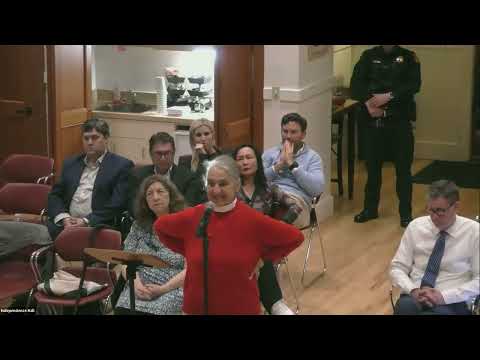
Area B—the intersection at Woodside, Kinyatta and Mountain Home near Robert's Grocery—prompted the meeting’s most intense exchange. Consultants offered three concepts: a minimalist safety‑and‑crosswalk scheme with clarified parallel parking; elimination of the free right (slip) lane to expand Alec Donald Park; and a radical reconfiguration that would convert the slip lane into two travel lanes and create a larger park/parking reallocation. Robert's Market owner Christine Roberts and trustee Suzanne Roberts Vandenberg warned the council that losing or relocating adjacent parking would be operationally and financially devastating. "You cannot replace parking. People will not come to your business if they cannot park," Christine Roberts said, describing razor‑thin margins, weekly delivery constraints and ongoing enforcement costs to keep parking available for customers.
Roberts' attorney, Lee Prince, presented a legal/land‑title concern: he said the parcel boundaries and right‑of‑way depictions in county maps differ from Roberts’ record of survey, and he urged the council to pause concepts that depend on assumed Town or CALTRANS right‑of‑way until ownership and easement questions are resolved.
Council direction: members expressed broad agreement on prioritizing parking and business viability before advancing large park concepts that would remove front‑door stalls; multiple council members asked consultants to bridge the CAC’s recommendations and business concerns, undertake further survey work (property lines, right‑of‑way), and return with refined proposals. Several council members supported lower‑cost safety measures (Concept 0 / Concept 1 variants) as near‑term options, while asking the CAC to revisit the roundabout and merge‑lane proposals for Whiskey Hill (Area D) and for staff to study potential funding sources for more expensive north‑side paths.
Other outcomes: the council signaled support for improving the rear shared street behind storefronts (Area C) as a minimally invasive way to improve pedestrian experience without removing parking; it also expressed interest in continuing to explore roundabout or mini‑roundabout options at Whiskey Hill to slow traffic while maintaining flow.
Next steps: Good City will workshop revised concepts that prioritize parking and business buy‑in, conduct any necessary right‑of‑way and drainage surveys, and return to the CAC and council before initiating the CEQA/SEQ process and formal plan adoption steps.