Get Full Government Meeting Transcripts, Videos, & Alerts Forever!
Get email alerts on the School Construction topic
No spam. Unsubscribe anytime.
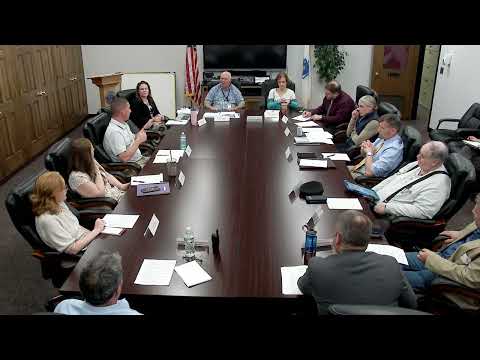
School building committee presses outreach as feasibility study votes loom
Summary
At its April 27 meeting the Shawsheen Valley regional school building committee reviewed MSBA documents showing current enrollment and potential capacity, outlined outreach and messaging for imminent town votes and agreed next steps including OPM procurement if feasibility funding is approved.
The Shawsheen Valley Regional Vocational Technical school building committee on April 27 reviewed recent MSBA and Department of Education materials, discussed enrollment and capacity figures, and agreed on outreach steps as town votes on feasibility funding approach.
Committee leaders told members they received a Department of Education chapter-74 viability document dated April 21 that lists a possible school capacity of 1,643 students and current enrollment of 1,292. A committee member said, "possible capacity is 1,643 students; currently we have 1,292, according to this document," and offered to distribute copies to committee members.
Members emphasized that the feasibility study is the next formal step and must be approved by all five sending towns. A committee member said the study will clarify whether the district should pursue renovation, an addition, or a new building and noted MSBA may offset a portion of costs for either option. "If you don't spend the money for the feasibility study, MSBA kind of washes its hands of the whole thing and then 100% of costs fall on our sending communities," the member warned.
The committee discussed practical outreach tactics to explain costs and trade-offs to municipal finance committees and voters. Recommendations included staffed booths at town events, a mobile display or trifold prepared by the district graphics unit, a QR code linking to a centralized project landing page with FAQs, and targeted open-house tours for select boards and finance committees. A staff member said she would "put the packet in there from tonight so everybody" can verify access to shared documents.
Members also reviewed example household-cost messaging to make large project numbers relatable. Using a hypothetical $300 million project, a conservative 20% MSBA reimbursement and a 4% interest assumption, a committee member offered an illustrative breakdown of about "$16 per month in a household" to help voters grasp potential impact—emphasizing the number was an illustrative example, not a final estimate.
Specific program questions were raised: the committee noted MSBA typically does not reimburse certain items such as pools, so decisions about amenities may be treated as separate or prioritized based on district goals. Members urged caution in public imagery—recommending materials that show maintenance needs and overcrowding without portraying the school as unattractive to prospective students.
If feasibility funding is approved by the towns and MSBA, members said the next administrative step will be to procure an Owner's Project Manager (OPM) using MSBA templates and to create a small OPM selection committee. The committee asked staff to prepare an RFP template and to propose dates for a May meeting after town votes are complete.
The committee approved the minutes at the start of the meeting, discussed public-comment placement on future agendas, and adjourned by unanimous voice vote. The committee said it will reconvene after the upcoming round of town meetings to review results and, if approved, begin the MSBA-triggered procurement and design process.