Get Full Government Meeting Transcripts, Videos, & Alerts Forever!
Get email alerts on the School Redistricting topic
No spam. Unsubscribe anytime.
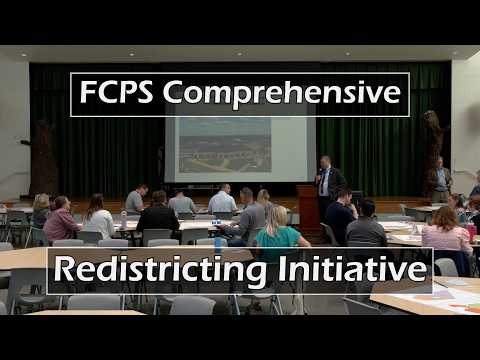
Frederick County Public Schools holds pre‑scenario redistricting meeting; staff outline 2027 elementary and 2029 secondary timelines
Summary
Frederick County Public Schools hosted a community meeting to gather input for boundary scenarios ahead of planned school expansions. Staff and consultants said three draft scenarios will be developed over the summer, presented in the fall, with elementary rezoning set for fall 2027 and secondary changes tied to a new high school opening in fall 2029.
Superintendent opened the meeting by urging residents to bring concerns directly to staff as the district begins a multi‑year redistricting process to rebalance school enrollments and plan for a fourth high school.
“We are at 120% capacity at our three current high schools,” the Superintendent said, arguing the district must spread students across four sites to be “good stewards of the taxpayer dollar.” Consultants from WXY Studio and Public Engagement Associates described a four‑phase process: prescenario engagement (now), draft scenario development (this summer), public review with an interactive boundary explorer (fall), and final recommendations to committees and the school board in winter.
Chris Rice of WXY Studio told the room the new high school is scheduled to open in 2029 and that the project team will draft three boundary scenarios this summer informed by utilization rates, travel distances, feeder patterns and demographic data. “We’ll develop three scenarios over the course of the summer and present them back to the whole community in the fall,” Rice said.
Mario Gampier presented maps showing uneven utilization across the district: some elementary and middle schools are underutilized while two high schools on the eastern and southern sides are heavily overcapacity. He said the district’s target utilization range is 80%–95% and noted that, city‑wide, about 40% of students are eligible for free or reduced‑price lunch.
Staff and consultants emphasized plan horizons of five to ten years, citing several pipeline residential developments that are expected to produce student yields. The team showed a modeling exercise that projects growing pressure on both top and bottom utilization bands without boundary changes and without the planned capital projects (Jordan Springs and Middletown expansions and the fourth high school).
In question‑and‑answer exchanges, Logan Shepard, the district’s director of planning and construction, said elementary rezoning would take effect in fall 2027 while middle‑ and high‑school changes would align with the fourth high school’s opening in fall 2029. Wayne Lee, coordinator of planning and construction, acknowledged a middle‑school capacity shortfall and said addressing it depends on securing funding to open additional middle‑school seats.
Residents pressed staff about feeder patterns, grandfathering for students mid‑transition, and developer funding. One resident said Snowden Bridge generated substantially more students per 100 houses (about 55) than the county average (about 35); staff said that higher local yield required expansion and will complicate redistricting trade‑offs. On funding, presenters explained that proffers and developer contributions can come with rezonings but that a 2016 change in Virginia law limits local authority to require such contributions; staff said proffer funds reduce, but do not eliminate, taxpayer costs for expansion.
Table discussions and a roomwide poll ranked balancing building utilization and minimizing impact on students as the two highest priorities. Staff collected worksheets and poll results for use in scenario development and encouraged ongoing input via the project website and email.
The next steps: the redistricting committee will meet, consultants will draft three scenarios this summer, the team will present those in October with an interactive boundary explorer so residents can test addresses, and a refined recommendation will go to the building and grounds committee and school board for action in the winter. Specific policy decisions—such as grandfathering, phased openings and transportation options—were not finalized and will be decided later by the school board.