Get Full Government Meeting Transcripts, Videos, & Alerts Forever!
Get email alerts on the Micromobility Enforcement topic
No spam. Unsubscribe anytime.
Liberty Lake officials launch education-to-enforcement plan for ebikes, scooters and golf carts
Summary
Police and fire officials in Liberty Lake outlined state rules, rising injury trends and a three-phase enforcement plan that moves from education to proactive enforcement beginning July 1, with towing and juvenile device holds for repeat or egregious violations.
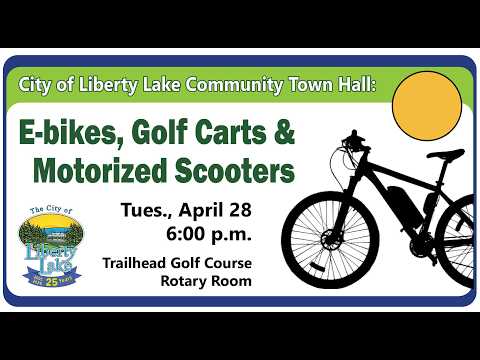
Liberty Lake — City police and fire officials told a packed public forum that growing use of ebikes, motorized scooters and golf carts has outpaced awareness and enforcement, and announced a stepped approach that will move from outreach to active enforcement starting July 1.
Chief Don Simmons, the city’s police chief, said the forum was intended to clarify state law and local ordinances and to reduce injuries. "We have the ability to tow electric [devices] ... if it's being operated by anyone who is not a licensed driver," Simmons said, citing enforcement powers available under state law and municipal code. He also stressed helmet safety and cited national injury data raised in the presentation.
The nut graf: Officials said they will first post materials and run outreach with schools and community groups, then spend several weeks issuing warnings and contacting parents; beginning July 1 the department will be more proactive, including towing devices in some cases and charging civil infractions or requiring parental pickup for juvenile-operated devices.
Deputy Chief DC Morgan described the three-phase plan in detail: an education phase now, an intensified-warning period through about July 1 and prompter enforcement afterward. "We're going to give warnings until July 1st. As of July 1st ... we're going to start being a little bit more proactive with the enforcement," Morgan said.
Panelists walked attendees through how Washington law treats different devices. Chief Simmons summarized the state definitions used in the Revised Code of Washington: Class 1 and Class 2 ebikes provide assistance up to 20 miles per hour (Class 2 may propel without pedaling), Class 3 ebikes assist up to roughly 28 mph and are subject to additional restrictions including a minimum age of 16 for operation on public streets and shared-use paths unless a municipality posts otherwise. He warned that some electrically powered vehicles marketed as "ebikes" lack pedals or have motorcycle-style pegs and are classified as motorcycles or off-road vehicles under state law, requiring registration and licensing.
First responders described local impacts. Joe Kosher, identified as captain of community risk reduction for Spokane Valley, said hospital and valley-wide numbers show a rising trend in ebike and scooter incidents and that local reporting systems complicate precise counts. Per the presentation, Sacred Heart hospital recorded 112 ebike-related ER visits between 2024 and 2025 (up from about 22 in 2023) and valleywide incident reporting rose substantially; locally the panel reported about 10 incidents this year involving golf carts or e-scooters. Kosher said much of the community risk involves younger riders who lack situational experience.
Officials explained municipal code provisions: motorized foot scooters are limited to devices with small wheels and are prohibited on city-owned parks, sidewalks and trails; scooter operators must be 16 or older; golf carts must be driven by a valid licensed driver, carry a seat for each passenger and generally may not be operated on streets with posted speed limits above 25 mph. The panel said violations can be civil infractions (fines up to the municipal limit), and police may pursue tow and juvenile referral options.
Audience members raised concerns about parking-lot safety, trail use (including the Centennial Trail) and park damage. A public commenter recounted a fatal crash in another community and its long-term effect on the driver’s family: "My uncle became an alcoholic and then took his life because he never got over killing that child," the resident said, urging caution. Officials replied that cameras and reports can identify trespass and property damage and that they will prioritize calls for imminent danger while using discretion for routine compliance issues.
The panel said it will provide the full presentation and links to the cited Revised Code of Washington provisions on the police department website, coordinate school assemblies and middle-school classes via school resource officers and staff (Katie Ferris was named as coordinating outreach), and continue the conversation as state legislation evolves. They encouraged community members to call 911 for dangerous or threatening behavior and to report park damage so investigators can review camera footage.
What happens next: outreach materials and the recorded presentation will be posted online; officers will spend the next several weeks issuing warnings and notifying parents; and the department plans to move toward more active enforcement beginning July 1, including device towing and civil citations for repeat or serious violations. Officials asked residents to help by supervising minors, using approved safety gear and reporting hazardous incidents.
No formal votes or new ordinances were adopted at the forum; officials said changes to enforcement practice reflect internal policy and RCW authorities and that any formal ordinance changes would follow separate legislative or council processes.