Get Full Government Meeting Transcripts, Videos, & Alerts Forever!
Get email alerts on the Historic Preservation topic
No spam. Unsubscribe anytime.
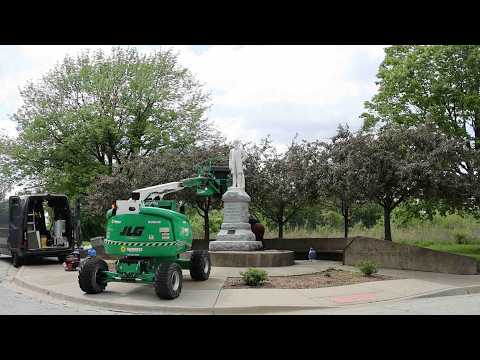
Presenter details restoration of John Brown statue, calls it a "piece of history"
Summary
A presenter described a conservation project to remove graffiti and rust-like staining from a marble statue of John Brown, saying stone-safe paint strippers, a three-day poultice process and CO2 sublimation (dry ice) were used to avoid damaging the marble.
A presenter described a recent conservation project to restore a marble statue of John Brown, saying specialized stone-safe paint removers, a three-day poultice and CO2 sublimation (dry ice) were used to remove graffiti and preserve the marble.
The presenter said the statue had been graffitied “about, I guess, 10 or 15 years ago,” and that previous responses had included painting over the graffiti rather than properly removing it. “We rebuilt several areas that were lost on the marble,” the presenter said.
On technique, the presenter said removing the paint took three days and required a paint stripper specifically designed for stone, followed by CO2 sublimation to remove the final layer without damaging the surface. The presenter added that some markings appeared to be from a felt-tip marker: “I think it was Sharpie, probably,” and that a special poultice was applied to extract that ink.
After removing paint, conservators found extensive staining that the presenter described as resembling rust. To address that, the presenter said they wet the stone, applied a chemical treatment across the sculpture, and rinsed it thoroughly, describing the approach as a “conservation-grade treatment for the stone.”
The presenter identified the work as a statue of John Brown and noted its historical significance, saying, “He was uh anti-slavery,” and asserting that the statue “was the first sculpture commissioned by a black community on record.” The presenter placed the commission in historical context, saying it was installed at the same time communities were erecting Confederate monuments and calling it “a huge... piece of history.”
No municipal affiliation or the statue’s location was specified in the transcript, and the record shows no formal motion, vote or policy action tied to the remarks. An attendee briefly interjected with the word “Hey,” but no substantive exchange followed in the provided transcript.
The presentation focused on technical conservation choices and the presenter’s historical claim; the transcript does not record later verification of the commissioning claim or any formal next steps recorded at the time.