Get Full Government Meeting Transcripts, Videos, & Alerts Forever!
Get email alerts on the Economic Development topic
No spam. Unsubscribe anytime.
Titusville names economic development board and favors budget‑based funding approach
Summary
Council appointed seven members to a new Economic Development Organization board and directed staff to use a restricted, council‑controlled fund (seeded by available balances) as the initial EDO funding strategy while staff develops longer-term growth‑capture mechanisms.
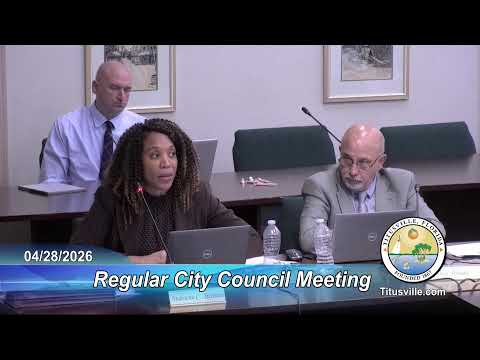
The City Council confirmed appointments to the newly formed Economic Development Organization (EDO) and set an interim funding approach on April 28.
Council appointed seven members nominated from applicants and chamber recommendations to staggered terms after public testimony from applicants and community members. Appointees included Bart Genchin, Tanya Hudson, Sean Hollis, Stan Ratz, Edna Wilson, Amir Hatum and Dan Aton (motions and roll-call votes recorded). Several public commenters raised concerns about past development incentives and urged stronger public oversight of economic development spending.
Staff presented three funding options for the EDO: (1) a portion of FPL franchise-fee growth tied to new development, (2) a district-based ad-valorem increment capture (a growth‑capture TIFF-like model), and (3) a restricted city fund seeded through the annual budget process. Economic development director Nick G. recommended Strategy 3 — a restricted fund administered through the city budget with council oversight — as the most practical under current fiscal uncertainty. Council voted unanimously to adopt Strategy 3 as the preferred initial funding approach and directed staff to seed the fund from available balances and return with a resolution and administrative parameters.
Council members said the approach preserves council discretion, allows immediate capitalization to get the EDO started, and leaves room to develop growth-capture mechanisms (for example franchise-fee set-asides) later if desired. Staff noted additional steps: establishing EDO bylaws, defining measurable outcomes, and returning to council with implementation rules and any necessary budget amendments.