Get Full Government Meeting Transcripts, Videos, & Alerts Forever!
Get email alerts on the EMS Agreement topic
No spam. Unsubscribe anytime.
Cross Plains weighs revised regional EMS agreement as July 1 leverage deadline looms
Summary
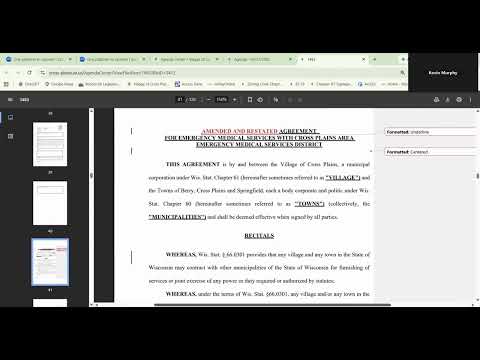
Village officials spent the bulk of the meeting reviewing a redlined draft regional emergency medical services agreement, debating funding formulas, governance language, and withdrawal rules; staff warned the village’s leverage to secure preferred contract terms expires July 1 and urged review of a final draft before a May vote.
Village of Cross Plains officials devoted the largest portion of their April 27 meeting to a line‑by‑line review of a draft regional emergency medical services (EMS) agreement prepared by a municipal attorney.
The Village Administrator (Bobby) led the review, identifying multiple edits the village requested — including removal of a requirement for "certified copies," clarification of who signs or approves invoices, and changes to withdrawal notice cycles. He told trustees the draft attempts to keep operational practice aligned with audit expectations while creating financial protections for the municipality.
The draft links cost changes to the urban consumer price index (CPI) plus two percentage points and creates a five‑year allowance of up to 10% spending without full municipal board approval. Bobby said that if fees grow faster than CPI+2 or exceed the five‑year cap, any increase would require approval by every participating municipal board.
"The key to this is our leverage ends July 1st," Bobby said, urging trustees to review a final draft in May so the village can influence the terms. He outlined three paths: approve the final draft in May; call a special meeting in early June to act; or, as a last resort, withdraw and protect village reserves while offering alternate contract arrangements.
Trustees questioned governance language, expressing concern that the draft placed duties and financial controls in ways that did not match current practice. Several sections clarified the roles of the chief, secretary and treasurer, and discussion focused on ensuring proper checks on expenditures — for example, thresholds that require board co‑signatures for large checks.
Board members also raised risks if neighboring towns chose different providers: response times for areas that depart could grow substantially, a point Bobby underscored when describing worst‑case scenarios for neighboring townships.
The Village Administrator said staff will circulate the final attorney‑reviewed draft when ready and that the Board will consider formal action in May; if the Board passes it locally, the draft will move to other municipal boards for their consideration.