Get Full Government Meeting Transcripts, Videos, & Alerts Forever!
Get email alerts on the Ethics Disclosure Review topic
No spam. Unsubscribe anytime.
Ithaca advisory board reviews annual financial disclosure forms, flags late filing and incomplete entries
Summary
At its first meeting, the city advisory board reviewed annual financial disclosure statements, identified one late filing (Patrick Cool) and multiple blank fields to be clarified, and agreed to request follow‑up information, coordinate with the city attorney, and schedule a meeting with the human resources director before next April's review.
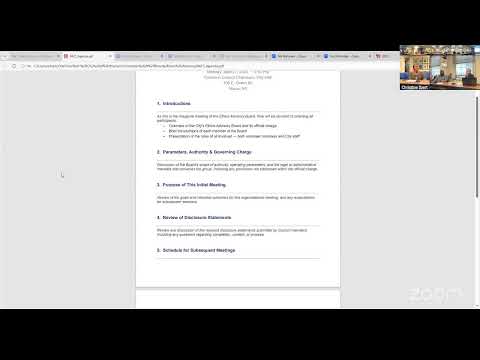
Members of the city advisory board met to conduct the annual review of financial disclosure statements required by City Code §55, examining timeliness, signatures and potential conflicts of interest. The presenter said most forms were filed and signed but that one—by Patrick Cool—had been entered in the system as filed late; the board recorded the late filing for its report and noted it has no statutory penalty to impose.
The board’s review focused on completeness and the substance of disclosures: employment, family members’ jobs and outside interests that could conflict with city business. Jim, who led the review, said the forms exist so the city attorney and common council can identify potential recusal or disclosure needs and that the board’s role is to flag issues for further review. “This is a very short read. You can all do it in 20 minutes or less,” Jim told members as he walked through the packet, urging them to note ambiguous entries and file dates.
Members flagged multiple blank fields across several filers and agreed to request that filers enter either an answer or “NA” so the record clearly shows a consideration of each disclosure question. The group also agreed to ask staff to audit the packet and produce a follow‑up list identifying where clarifications are needed; Chris volunteered to compile those notes and circulate a draft to the board.
The board discussed specific conflict scenarios to guide future flags to the city attorney, including employment at major local institutions such as Cornell and seats on outside bodies (IDA, TCAT) that some council members hold by city appointment. The presenter noted that city‑appointed seats are often viewed differently from personal outside employment and that the city attorney typically handles determinations about voting conflicts, but the advisory board can act as a second set of eyes and formally send a list of items for the city attorney’s attention.
Members also raised an administrative clarification: a council member who is listed as “Jorge” in council materials but signed a disclosure as “George.” The board agreed it could request a notation or clarification to match the record and avoid confusion in future reviews.
On procedure and scheduling, the board agreed to request training materials from the human resources director and to target a follow‑up review and meeting in February so materials can be examined ahead of the April annual certification. The presenter reminded members that a complaint or request for an advisory opinion would require the board to convene within 30 days. The meeting concluded without any formal enforcement actions; members moved to adjourn.
Next steps: staff will produce a draft list of required clarifications to send to filers; the board will consider formalizing guidance on when to flag matters for the city attorney; and the board plans a follow‑up administrative meeting to review HR training materials ahead of next April’s required review.