Get Full Government Meeting Transcripts, Videos, & Alerts Forever!
Get email alerts on the Fundraising topic
No spam. Unsubscribe anytime.
Parents urge pause to foundation reform while others warn pause would undercut equity
Summary
Dozens of speakers at public comment pressed opposing views: some parents asked the board to pause the 2024 policy that restricts local school foundations from funding staff, arguing immediate help is needed for students; others and the student representative said reverting would reintroduce inequity and undermine a district-wide fundraising model.
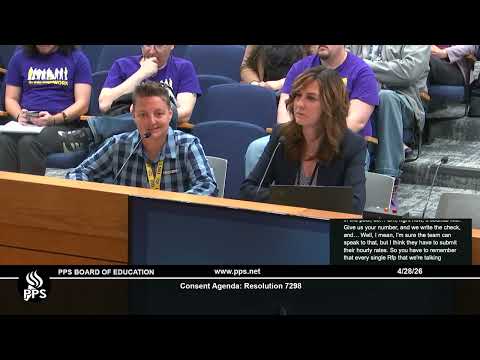
The Portland Public Schools board heard sharply divided public testimony and an extended board debate on April 28 about whether to pause last year's policy that limits local school foundations from directly funding staff positions.
"Either pause the foundation policy now while we fix this and create a transition plan, or decide tonight to implement a pause if the fund does not raise its promised $1 million in unrestricted money for staffing by the end of June," said a parent and co-chair of a parent advisory committee during the public comment period, urging immediate flexibility for local fundraising at affected schools.
Director Rosianne Sullivan formally proposed a temporary pause on the May 2024 amendment, citing examples of schools that previously used foundation grants to fund staff such as college-career coordinators and reading tutors. Sullivan argued even small amounts of staff funding (she described ".5 FTE" examples) could be the difference for students in key developmental windows.
Opponents, including the district's student representative and several board members, said returning to local school foundations would resurrect a two-tiered system in which wealthier school communities sustain additional staff while others fall further behind. "To believe in equity only when it is easy is not to believe in equity at all," the student representative said in a statement the district student council approved unanimously.
Nick Broadniki, interim executive director of the Fund for PPS, told the board he has spent the past 90 days meeting with more than 200 stakeholders and has stood up basic fundraising infrastructure: a CRM, a peer-to-peer platform, a school liaison committee, corporate sponsorship structures and a 16-week communications campaign. He said the fund is already deploying resources (high-impact tutoring, food pantries and high-school math supports) and asked for community and board partnership to grow it.
Board members were split. Several urged patience and asked staff and the fund to accelerate outreach and performance reporting; others said the fund is the right policy direction and reversing the reform would re-introduce inequitable outcomes. The board did not pass a resolution to pause the policy on April 28. Directors asked staff for additional data, a timeline for evaluating fund performance, and continued public engagement.
What happens next: board members said they would continue discussions and consider whether a time-limited evaluation benchmark (for example, a six- or 12-month check) should be adopted to judge progress on the fund and whether policy adjustments are needed.