Get Full Government Meeting Transcripts, Videos, & Alerts Forever!
Get email alerts on the School Budgeting topic
No spam. Unsubscribe anytime.
Rutherford County school leaders warn charter projections, enrollment shifts and textbook costs could force millions in upfront budgeting
Summary
At an April 28 Health & Education Committee meeting, school leaders said state funding tied to projected enrollment and charter schools’ enrollment claims could require the district to set aside millions up front, potentially limiting raises and prompting use of fund balance.
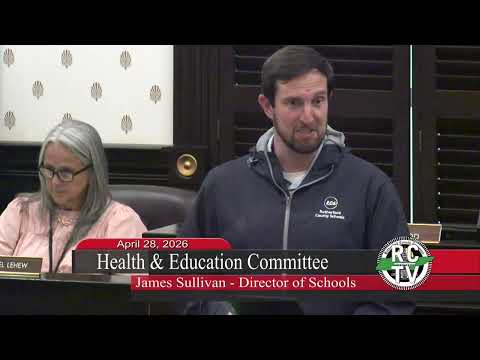
Dr. Sullivan, speaking to the Rutherford County Health and Education Committee on April 28, told commissioners that school funding is driven by the state Education Information System and the TISA formula and that large charter enrollment projections can force the district to budget significant amounts before pupil counts are finalized.
“Absolutely not,” Dr. Sullivan said when denying a circulating suggestion that the district artificially inflates enrollment to collect more state funding; he described such behavior as fraudulent and noted that the state’s accountability and funding processes create penalties for chronic absenteeism.
Why it matters: the district reported a budgeted deficit that has fluctuated between roughly $12 million (two years ago), $8 million last year and about $12 million this year without local revenue. Dr. Sullivan said the district is already planning to leave 70 positions vacant as a cost-control measure, and the proposed cost-of-living adjustment is 1.7% (the district’s stated target is 2%). He said rising state insurance costs (10–12% projected) cut into available funds for raises.
Charter projections and timing: Dr. Sullivan used a recently approved charter and a second example to illustrate the risk. One charter with about 406 students projected 600 next year; the district set aside roughly $2 million to cover that projection because funds flow to charter schools at the start of the school year and are reconciled later. He warned that a proposed Rutherford Collegiate Prep projecting about 1,000 students could prompt roughly $15 million in upfront obligations if state rules remain unchanged.
The mechanics are important for timing: Dr. Sullivan explained that enrollment is reported through vendor systems (Skyward or other state vendors), funds are distributed through TISA in August, and an October “true-up” corrects overpayments; the earliest realistic return of excess funds to the district would likely be December after internal budget amendments.
Textbooks and procurement choices: the state’s move to an eight-year textbook adoption raised a separate budget challenge. At about 52,000 students and roughly $180 per textbook, Dr. Sullivan estimated an $8–$12 million cost for the current adoption cycle. Buying all materials up front yields an estimated 8–10% discount but increases short-term deficits; spreading purchases across years or using fund balance are the alternatives.
What’s next: the school administration and the commission will continue the budget process with a public budget workshop on May 7, a work session on May 11 and a statutory meeting to pass the budget on May 14; the commission’s joint budget meeting is set for May 26.