Get Full Government Meeting Transcripts, Videos, & Alerts Forever!
Get email alerts on the Victim Services topic
No spam. Unsubscribe anytime.
Commission delays decision to redirect victims-assistance funds to sheriff's Bridge to Safety program
Summary
After a daylong presentation and extended debate, Knox County commissioners voted 6'5 to postpone a resolution that would redirect court-collected victims-assistance assessment funds to the sheriff's Victims Assistance Fund to support the county's Bridge to Safety program, ordering mediation and a 60-day follow-up.
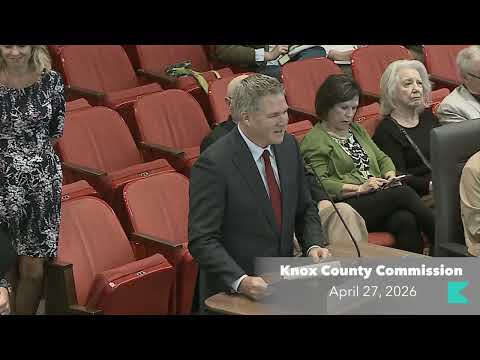
Knox County commissioners on April 27 postponed for 60 days a resolution that would have directed court-collected victims-assistance assessment funds to the Knox County Sheriff's Victims Assistance Fund to support the newly launched Bridge to Safety program.
Criminal court clerk Mike Hammond told the commission the Bridge to Safety launched last October to provide a 24-hour helpline and coordinated victim services in partnership with law enforcement, Helen Ross McNabb, the YWCA and Legal Aid. "There is no charge for our services," Hammond said, adding that the program has helped more than 150 people so far and that every penny designated for victims would be used for direct assistance. He asked the commission to transfer those assessment funds to the sheriff's program and pledged quarterly accounting of expenditures.
Supporters of the transfer included former district attorney Randy Nichols, who said the county needed to "break the cycle" of domestic violence and called the proposed funding arrangement "a beautiful thing."
But leaders of the existing Knoxville Family Justice Center urged the commission not to reassign the funds. Clay Puit, president of the FJC board, said the nonprofit has served the community for 20 years and remains the county-designated victim assistance program under the commission's 2011 resolution. "Among the 2,700 victims who came to us last year, 90% reported a high level of satisfaction with our services," said Stephanie Herb, chief development officer. Interim executive director Shannon Lee said the nonprofit has a network of corporate partners and a long record of community-funded services and warned that losing the assessment revenue would be devastating while the organization recovers from lost grant funding.
Commissioners pressed both sides on operational details: what services are available 24/7, who staffs the hotline, whether services would be duplicated, and how much of the FJC's budget depends on the assessment revenue. Terry Lawrence, a victim advocate with the sheriff's office, described day-to-day work—transportation, hotel placements, gift cards and clothing—that the sheriff's advocates provide to people who flee abusive situations.
After more than three hours of public testimony and commissioner questioning, Commissioner Durret offered a substitute motion to postpone the resolution for 60 days to allow the Family Justice Center and the Bridge to Safety team to meet, consider mediation, and return with clearer plans. The motion passed 6'5. The chair asked the parties to meet and report back at the reconvened session.
What happened next: the commission did not adopt the funding transfer and requires the proponents and the Family Justice Center to meet and provide additional information before taking a final vote.
Why it matters: the dollars in question are derived from court assessments intended to support victims; redirecting them would move an established nonprofit's designated funds to a county-run program, a shift with budgetary, service-delivery and oversight implications. The commission's postponement reflects concerns about service continuity and a desire for mediation before changing a longstanding designation.
The commission's files: the substitute motion to postpone passed with a 6'5 tally. The minutes record that the no votes were Oster, Russell, Lee, Fox and Frasier. The matter will return after the parties meet and the commission receives further documentation.
(Reporting staff: quotes and attributions are drawn from the April 27 Knox County Commission minutes and transcript; speakers are identified by how they introduced themselves on the record.)