Get Full Government Meeting Transcripts, Videos, & Alerts Forever!
Get email alerts on the Parking topic
No spam. Unsubscribe anytime.
After hours of public comment, Ogden council approves phased managed parking and fees for downtown
Summary
Following several hours of presentations and a lengthy public comment period dominated by downtown business owners and residents, the council voted 5-2 to authorize a phased managed-parking program and separately approved the associated fee ordinance and schedule.
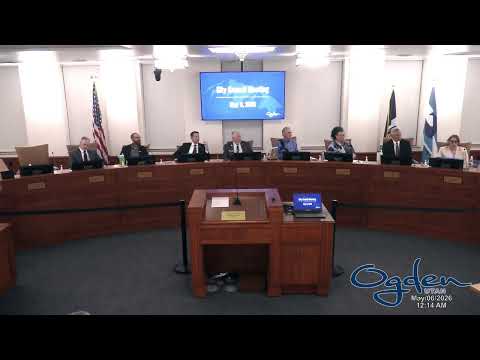
The Ogden City Council on May 5 authorized a phased managed-parking program for parts of downtown and approved a fee ordinance after an extended hearing that drew dozens of residents and business owners.
City staff framed the proposal as a phased, data-driven approach to address high-demand hotspots (notably 25th Street and areas adjacent to City Hall) and to leverage recent investments such as the Wonderblock garage. Lisa Stout, a city parking lead, told the council that the proposal involves two ordinances: one to authorize a managed parking system and another to set rates. Consultant Robert Ferren of Kimley Horn summarized the study'finding that overall downtown parking occupancy was roughly 50% but that localized peaks exceeded healthy thresholds, arguing that managed parking increases turnover and reduces "circling" for spaces.
Officials proposed using a Passport mobile payment system with kiosks and pay-by-license enforcement, a 30-day introductory free period for users, and parking ambassadors to prioritize customer education. Proposed rates discussed during the hearing included on-street $1.50'$2.00 per hour and off-street $1.00'$1.50 per hour (no time-limit), EV rates higher at roughly $2.75'$3.00 per hour, maximum daily caps of $15'$18, unreserved monthly garage permits at $80 and a $10 monthly processing fee for business employee permit administration. Staff also proposed a 15-minute short-stop window (app-registered) with the city covering the transaction costs.
The hearing produced substantial public opposition from downtown merchants and community groups, who warned paid parking would reduce foot traffic and disproportionately affect seniors, low-income residents and workers. Business owners also disputed projected revenue models and raised concerns that the city would have to use BDO lease revenues to cover bond debt during a multi-year ramp-up. Supporters, including some developers and planners, argued the program will improve turnover and long-term access for customers.
Council debated two options: a narrower phase-one footprint or a broader multi-phase authorization. On a roll-call vote the council adopted Option Two, the broader phased authorization, 5-2 (Lopez yes; Lendell no; Myers yes; Richie yes; Washington no; Vice Chair Graph yes; Chair Hire yes). The accompanying fee ordinance passed by the same margin. Staff said enforcement hours will be weekdays and Saturday (8 a.m.-8 p.m.); citations and penalty structure remain as posted in the fee ordinance, and staff expects a stabilization period with monitoring and adjustments every 6-12 months.
Council members voiced continuing concern about the revenue model and the amount of temporary city subsidy anticipated to cover bond payments during the program ramp-up. Mayor and administration staff said the approach is intended as an initial, adaptive phase so the city can collect usage data, make adjustments, and target outreach and mitigation measures for small businesses and vulnerable residents.
Next steps: staff will begin implementation logistics, install kiosks, deploy ambassadors during the introductory free period, collect data during a stabilization window, and return to council as outcomes and adjustment needs emerge.