Get Full Government Meeting Transcripts, Videos, & Alerts Forever!
Get email alerts on the Healthcare Finance topic
No spam. Unsubscribe anytime.
Lawmakers hear warnings that Hennepin Healthcare faces growing uncompensated-care crisis, consider funding options
Summary
At an April 28 informational hearing, Hennepin Healthcare officials told the Minnesota House Health Finance and Policy Committee that uncompensated care rose from $40M in 2020 to $104M in 2024, staffing and cash reserves are strained, and county and legislative funding proposals — including a proposed 1% county sales tax — are being discussed to stabilize operations and capital needs.
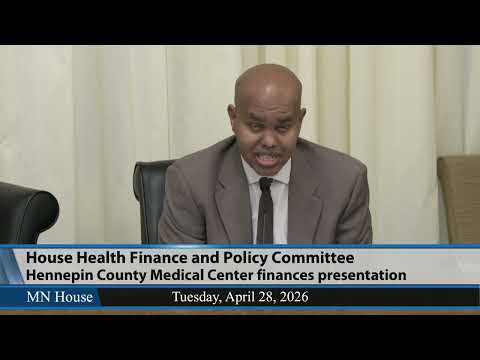
Chair Berman convened the Health Finance and Policy Committee on April 28, 2026, to hear an extended briefing on Hennepin Healthcare’s finances and proposals lawmakers could use to prevent further service disruptions.
Joni Wetland, Hennepin County administrator, opened the presentation, saying Hennepin Healthcare is a public safety-net system and that "uncompensated care is rapidly escalating — rising from $40 million in 2020 to $104 million in 2024," leaving the health system highly exposed to changes in Medicaid and other public payers. Wetland said about 75% of the system’s patients rely on Medicaid or Medicare and that combining self-pay with public-payer patients means "more than 80% of all patients" are served through public means.
The hearing underscored why the county and state are considering short‑ and longer‑term interventions. Abdi, Hennepin Healthcare’s chief financial officer, told the committee small percentage shifts in payer mix or unpaid claims produce large dollar swings and presented modeling — using Minnesota Hospital Association and DHS inputs — that staff said could yield a cumulative financial impact measured in the low billions over the next decade if current trends continue. Abdi said Hennepin has a comparatively high share of publicly funded patients, limited investment reserves and has relied on county support to prevent payroll interruptions this year.
Joe Matthews, Hennepin County’s chief financial officer, described the county campus and capital needs, and outlined Hennepin County’s draft option to expand a county sales tax (presentations described scenarios with up to a 1.0% rate) as a relatively predictable local revenue source for capital and ongoing support. Matthews said the county campus requires sustained investment to maintain aging buildings and listed annual maintenance pressures in the tens of millions of dollars.
Clinicians highlighted the system’s regional role. Nate Scott, vice president for hospital services and a practicing emergency physician at Hennepin Healthcare, said the hospital operates Minnesota’s busiest level‑one adult and pediatric trauma center and a verified burn center; he noted that roughly 40% of transfers and about 30% of inpatient volume come from outside Hennepin County and warned that losing capacity would strain other systems across the Upper Midwest.
Committee members pressed presenters on immediate and structural remedies. Members asked whether state general fund dollars, county levies or targeted pools (including proposals described by bill authors during the hearing) should be used. In questioning, several members raised governance and transparency concerns: county staff said the Hennepin County Board had stepped in last year with property‑tax support and a temporary financial backstop and is pursuing a recruitment process for a permanent HHS governing board to increase transparency and oversight.
Why it matters: Hennepin County Medical Center is a regional safety‑net provider of highly specialized services. Committee members and state advisers said stabilizing Hennepin’s finances could be essential to preserve trauma, burn and transplant services that are limited or unavailable elsewhere in the state.
What’s next: Lawmakers offered several competing proposals during the hearing — including a county sales‑tax option, a governance‑and‑general‑fund hybrid, and a time‑limited general fund stabilization package — and said more hearings and budget work are expected as the session continues. The committee adjourned after receiving bill summaries and dozens of member questions.