Get Full Government Meeting Transcripts, Videos, & Alerts Forever!
Get email alerts on the Maritime Security topic
No spam. Unsubscribe anytime.
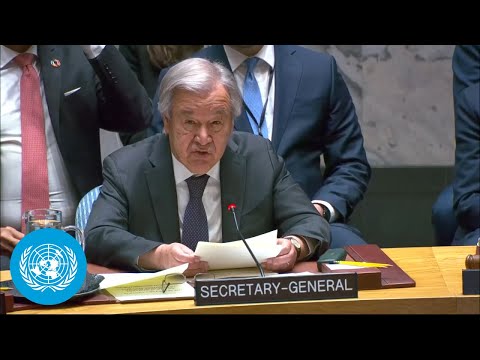
Secretary‑General Antonio Guterres urges reopening of Strait of Hormuz, warns of food and energy shocks
Summary
At an open debate, Secretary‑General Antonio Guterres warned that disruption through the Strait of Hormuz is straining global trade and food supplies, said more than 20,000 seafarers are stranded, and urged member states to back an IMO evacuation framework and uphold UN navigation rights.
Secretary‑General Antonio Guterres told the open debate that the safety of global waterways has become a test of the international order and appealed to parties to reopen the Strait of Hormuz so shipping can resume.
Guterres said the Strait of Hormuz is one of the world’s most critical maritime choke points and carries roughly one‑fifth of global oil trade, one‑fifth of global liquefied natural gas and nearly one‑third of internationally traded fertilizers. "I appeal to the parties, open the strait. Let ships pass. No tolls, no discrimination. Let trade resume. Let the global economy breathe," he said.
Why it matters: Guterres warned that disruption since early March has already triggered acute volatility in energy and commodity markets, surging transport and insurance costs and the worst supply‑chain disruptions since COVID‑19 and the war in Ukraine. He said those shocks are cascading into "empty fuel tanks, empty shelves, and empty plates," and that delays are slowing life‑saving deliveries during critical planting seasons, risking a global food emergency that would hit least developed countries and small island developing states hardest.
Guterres also highlighted the human toll: "More than 20,000 seafarers remain stranded at sea," he said, adding that over 2,000 commercial vessels are caught in restrictions to navigation. He stressed these men and women are civilian workers and "their safety, their well‑being, and their rights must be protected at all times and in all waters."
What he asked for: The secretary‑general urged member states to support an emergency evacuation framework prepared by the International Maritime Organization, calling for a coordinated plan to ensure the safe movement, assistance and protection of affected crews "in full accordance with international law." He reiterated that the UN Charter's prohibition on the threat or use of force applies at sea and cited the Council's resolution 2817 as affirming navigation rights and freedoms.
Guterres framed a diplomatic path forward, urging restraint, dialogue and confidence‑building and invoking articles 33 and 34 of chapter VI of the UN Charter on peaceful settlement of disputes. He pointed to the Black Sea Initiative as a prior example where practical cooperation helped reopen a blocked corridor and said the United Nations could convene and coordinate a similar, consent‑based arrangement if there is political will.
The president of the meeting thanked the secretary‑general for his briefing. No formal decision or vote was recorded in the transcript of this exchange.