Get Full Government Meeting Transcripts, Videos, & Alerts Forever!
Get email alerts on the Liquor Licenses topic
No spam. Unsubscribe anytime.
White House council interviews three applicants for retail liquor permits; staff seeks legal opinion on ownership limits
Summary
The White House City Council heard presentations from three applicants seeking retail liquor licenses at proposed locations on Raymond Hurst/Hirs Parkway and Highway 31W. Council staff asked applicants to provide a legal opinion on Tennessee ownership limits by May 5 before the council advances any applications.
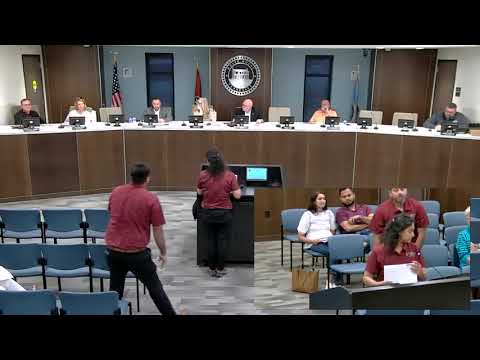
The White House City Council on Monday interviewed three applicants seeking new retail liquor-store permits and asked them to provide legal confirmation by May 5 that their ownership structures comply with Tennessee licensing limits.
At the outset of the meeting the council adopted the agenda without objection. No public commenters had signed up.
Benjal Patel, speaking as the applicant for Red Carpet Liquors number three, described a family-run proposal for a 10,000-square-foot building on Raymond Hurst Parkway (Parcel ID 077086.02) that would allocate roughly 7,000 square feet to package sales and about 3,000 square feet to an on-site restaurant or bar. Patel said the project would create “at least 10 to 15 local jobs” and boost local and state sales tax revenue. “Our mission is to provide the biggest… variety of alcoholic beverages,” Patel said, noting the company already operates two stores in “Gatin and Lebanon” as transcribed and that staff complete annual responsible‑vendor training.
Council members and staff raised questions about state limits on the number of retail licenses per person and the risk that indirect ownership or landlord arrangements could trigger a violation. One member summarized the relevant rule as allowing an individual two licenses and flagged indirect ownership as potentially problematic. Derek, a staff member, asked when applicants could provide documentation to resolve the issue; he set a deadline of May 5 for an attorney opinion or state confirmation.
Patel said the prospective owners can obtain legal advice and named an attorney she has used for ABC issues, saying, “I have worked with a lawyer that specializes with the Tennessee ABC… his name is Will Cheeks.” She said adjustments — including dropping a liquor-by-the-drink component — would be possible depending on the Tennessee Alcoholic Beverage Commission’s guidance.
At the next interview, Gishma Patel presented Cider Grove Wine and Spirits for a corner site at Raymond Hirs (the transcript also uses the spelling Raymond Hurst) and Highway 31W inside the Cider Grove development. She described an upscale, high‑end retail concept with tasting events, a loyalty program, online ordering and a walk‑in cigar humidor. Patel said the building plan is “already approved,” which she said could speed construction if the license is granted. “We aim to be a premium upscale beverage retailer offering a diverse wide array of high‑end products,” she said.
Calpesh and Nlesh Patel applied on behalf of Superto Market for a proposed location at 2500 Highway 31W. They emphasized long local ties and business experience in convenience and fuel operations and said they are prepared to renovate the site or stop fuel sales to accommodate a liquor-business layout. They warned that locating near the city’s two existing liquor stores could “cannibalize” other local merchants and said they had previously removed employees involved in underage sales at a convenience operation and would implement a POS system requiring ID scans to prevent future violations.
No formal action on the permits was taken at the meeting. Staff directed applicants to provide legal clarification about Tennessee licensing and indirect‑ownership rules — including how landlord arrangements or related‑party ownership would be treated — before the council places the applications on a future agenda for decision.
The council is expected to consider the applications at a later meeting once staff have reviewed any attorney opinions or state ABC determinations provided by the applicants.