Get Full Government Meeting Transcripts, Videos, & Alerts Forever!
Get email alerts on the Transit Budget topic
No spam. Unsubscribe anytime.
Committee keeps Norman On Demand microtransit but trims hours and budget
Summary
At the April 23 Community Planning and Transportation Committee meeting, staff reported a small increase in fixed‑route ridership and proposed modest cuts to Norman On Demand microtransit that lower the FY27 cost roughly $61,000, supported in part by a $144,000 contribution from the University of Oklahoma.
At the April 23 meeting of the City Council Community Planning and Transportation Committee, Taylor Johnson, Transit and Parking Program Manager, summarized March ridership and outlined a revised FY27 transit budget that preserves the Norman On Demand microtransit service while reducing its cost.
Johnson told the committee Embark Norman recorded about 45,000 fixed‑route and paratransit rides in March, up from roughly 44,000 the previous March, and said fixed‑route service is on pace to reach about 500,000 rides this year. "We had 45,000 rides and that's about a thousand increase over March of last year," he said.
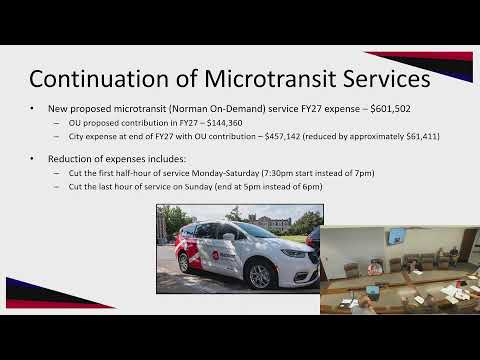
The budget discussion focused on microtransit. Staff said a February estimate of approximately $650,000 for Norman On Demand was reduced by about $61,000 to a revised total around $601,000 after service adjustments and revenue updates. The FTA apportionment for the transit fund increased by about $98,000, and the University of Oklahoma offered roughly $144,000 toward the microtransit program. Johnson said the remaining city share under the revised plan would be about $457,000.
To achieve savings, staff proposed operational changes: starting weekday and Saturday microtransit service at 7:30 p.m. instead of 7:00 p.m., and cutting the final hour on Sunday service (ending service at 5 p.m. instead of 6 p.m.). Johnson said the later‑evening demand is typically lower and fixed‑route service remains available during most of the affected hours. "We were given direction to add in the additional security services through Embark for all the whole service span and that has been reflected there," he said when summarizing budget adjustments.
Committee members asked whether ridership data supported the cutbacks and whether the program could be reconfigured to prioritize ADA‑accessible or same‑day paratransit needs. Johnson said staff have data on wheelchair‑accessible ride requests and that new paratransit software may eventually allow same‑day scheduling, but noted potential demand and funding challenges: because paratransit trips are typically fare‑free, that approach could create high demand unless other constraints are applied.
Johnson also said the city plans an RFP in the fall to test the market after four years with the current microtransit contractor and indicated the revised budget would be processed as a budget amendment in the usual course. "We were given direction to keep microtransit but shave the budget a little bit," he said, and added that staff would present the draft budget documents to council at the next meeting.
Next steps: staff will include the revised microtransit numbers in the FY27 budget documentation, issue an RFP in the fall for microtransit services, and return with any further data requested by council on ridership and service performance.