Get Full Government Meeting Transcripts, Videos, & Alerts Forever!
Get email alerts on the Zoning Ordinance topic
No spam. Unsubscribe anytime.
San Angelo officials outline zoning and water limits for proposed Skybox data center
Summary
City planning staff and Skybox representatives presented draft ordinances to allow large data centers by conditional use in industrial zones, ban cryptocurrency mining, set noise and setback limits, and cap cooling-loop fills and routine makeup water to limit withdrawals from city supplies.
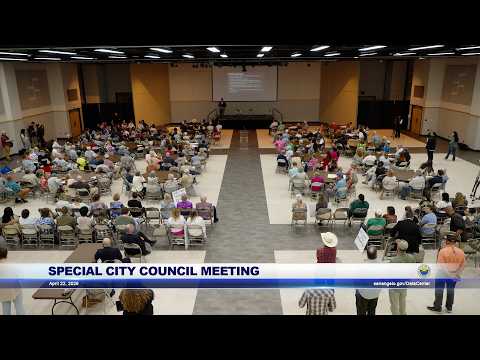
Aaron Vannoy, head of Planning and Development Services, laid out proposed zoning and utility rules for large data centers at a council-style public meeting on April 22, saying the projects would be allowed only as conditional uses in light- and heavy-manufacturing zones and would be subject to public notice, Planning Commission review and City Council appeal.
Vannoy said the ordinance would require applicants to submit site plans showing building locations and setbacks, ground-mounted equipment siting (generators and fuel tanks), parking and traffic circulation plans, photometric lighting details, fencing, landscaping and sound studies. "They have to give these plans to the city to put in the packet so that planning commissioners and the public can see those things," he said.
Key design and utility proposals described by Vannoy include a 75-foot maximum building height (with 10-foot stepbacks for any story above 50 feet), a 200-foot setback from any property line adjacent to a residence, a 50-foot setback for commercial/industrial adjacencies, and required screening of rooftop and ground-mounted equipment. The draft would also ban cryptocurrency mining as a data-center use.
On lighting and noise, staff proposed shielded lighting with a 30-foot maximum pole height and daytime/nighttime sound limits measured at the property line: 60 decibels during daytime and 55 at night. Vannoy said the ordinance includes octave-band analysis to address low-frequency "hum" concerns raised by residents.
Vannoy said the utility ordinance (chapter 11) would require data centers to employ closed-loop cooling or similar systems "which minimizes water use and eliminates the need for continuous withdrawals from the city's public water supply for heat rejection." The draft ordinance text read to the meeting sets an initial cooling-system fill limit of 15 gallons per square foot of gross building area within 12 months of obtaining a certificate of occupancy. It also allows a full drain-and-refill only as infrequently as once every three years and limits routine annual makeup water to no more than 3 percent of the installed cooling-loop volume per building per calendar year.
On wastewater, staff proposed new, data-center-specific definitions and controls: planned discharges would require 72-hour written notice to the Director of Water Utilities and pre-discharge sampling and lab verification; emergency discharges must be reported within four hours with a seven-day written incident report; and records of volumes and analytic results must be kept for at least three years. "The director of water utilities retains the authority to establish discharge flow limits and additional operation requirements necessary to protect the city's sanitary sewer infrastructure," Vannoy said.
Skybox Emergent representatives who followed staff remarks described technical approaches they said meet or exceed the city's draft rules. CEO Chris Sumpter and the company's technical lead, Mike, described closed-loop systems as analogous to an automobile radiator — "you fill it up with coolant; it's a closed loop" — and said Skybox plans on-site storage and treatment before any controlled discharge to the sewer system, continuous monitoring of water use and quality, and public reporting of monitoring data.
Skybox said it would perform independent noise modeling, use sound-attenuating enclosures for generators and stagger monthly engine-testing to daytime hours with prior notice to the city. The company also said it would work with utilities (AEP, ERCOT) on interconnection studies and, where transmission upgrades are required, such infrastructure and study costs are typically paid by the developer rather than passed on to ratepayers.
No zoning changes or ordinances were adopted at the meeting; staff presented the draft proposals and Skybox answered questions. The council did not take final action on the proposals during the session.