Get Full Government Meeting Transcripts, Videos, & Alerts Forever!
Get email alerts on the Invasive Species Management topic
No spam. Unsubscribe anytime.
Acadia vegetation manager outlines methods and trade-offs for invasive-plant control in Maine
Summary
Jesse Wheeler of Acadia National Park summarized mechanical, chemical and biological methods for managing invasive plants, emphasized integrated pest management and local permitting, and flagged shoreland rules and multi-year maintenance needs.
Jesse Wheeler, vegetation program manager at Acadia National Park, told attendees the choice of invasive-plant control should be site-specific and planned for the long term. “Choose the least aggressive method to do the job,” he said, urging managers to prioritize prevention, monitoring and revegetation.
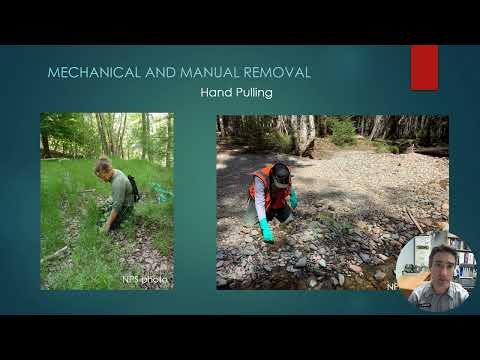
Wheeler described a range of physical methods — from forestry mulching and brush cutting to hand pulling and the weed-wrench tool — noting trade-offs between immediate removal and soil disturbance that can encourage reinvasion. He said heavy mechanical approaches are best used as a last resort when invasive cover is widespread because they remove native plants and require a solid revegetation plan.
For individual shrubs, Wheeler described stem-bagging (commercially marketed examples such as "Buckthorn Baggies") and said field trials at Acadia show roughly 50–75% mortality when bags remain in place across growing seasons; he recommended revisits to confirm death and to remove bagging materials afterward. For dense monocultures such as Japanese knotweed, he recommended smothering with heavy weed fabric and mulch, and warned some sites may need plastic/mulch in place for multiple years — “maybe up to 5 years,” he said — with continued monitoring.
On chemical options, Wheeler outlined common application techniques — foliar spray, basal-bark, cut-stem/cut-stump, hack-and-frill and stem injection — and repeatedly cautioned applicators to follow product labels. For foliar treatments he said applicators should seek about 90% foliage coverage and avoid spraying in high winds or immediately before rain to limit drift and off-target impacts. He recommended small targeted applicators ("dabbers") for cut-stem treatments where low spillover is important.
Wheeler said stem injection can be highly localized and suitable near water bodies with minimal off-target impacts but noted the technique is labor intensive and the equipment can be costly. He cautioned against using hack-and-frill beside trails or structures because it leaves standing dead trees that can become hazards.
Wheeler discussed nonchemical options including biological controls (for example, beetles used against purple loosestrife) and the use of managed grazing (goats or sheep) for large, palatable patches, while warning those methods are seldom perfectly selective and require planning for fecal seed spread and repeated visits.
Beyond techniques, Wheeler emphasized regulatory and community considerations. He described Maine’s town-level pesticide-notification registries and warned that town pesticide-use ordinances or organic farm protections may restrict product choices. He advised anyone planning work in shoreland zones or wetlands to consult Maine Department of Environmental Protection and local municipal officials to determine allowable disturbance and revegetation requirements.
Wheeler cited a shoreland example in Bucksport that allows removal of nonnative invasive vegetation under specific restrictions (hand tools within 25 feet, followed by revegetation). He also referenced a 2016 enforcement case in Kennebunk in which a land trust was fined (noted at $500 in Wheeler’s presentation) and faced remediation and surveyor costs after cutting shrubs in a shoreland area, underscoring enforcement risk for improperly permitted removals.
Wheeler closed by urging integrated, multi-year plans that balance invasive reduction with habitat goals — for example, weighing shrub removal against needs for early-successional habitat for species such as the New England cottontail — and provided contact information for follow-up. “It’s important that we... address the invasive plants that are currently here in Maine,” he said.