Get Full Government Meeting Transcripts, Videos, & Alerts Forever!
Get email alerts on the Budget topic
No spam. Unsubscribe anytime.
Leominster School Committee approves $116.6 million FY27 net school spending plan
Summary
The Leominster School Committee approved a Fiscal Year 2027 net school spending budget of $116,573,692 after a public hearing that outlined projected increases tied to the Student Opportunity Act and local contribution requirements; the plan funds 950 FTEs and adds positions to address enrollment and service needs.
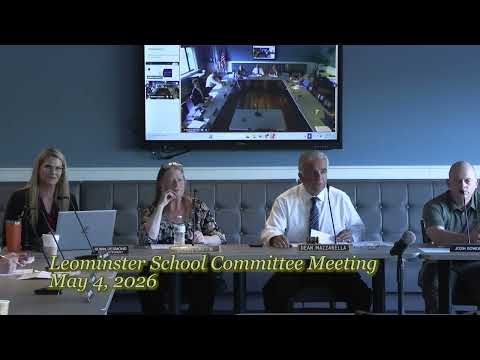
The Leominster School Committee on Monday approved a Fiscal Year 2027 net school spending budget of $116,573,692 after a public hearing and a motion to adopt the proposal.
During a presentation to the committee, the superintendent reported that preliminary net school spending is projected to rise by about $5.26 million for FY27, driven in part by $3.43 million in Chapter 78 (state) funding and an estimated $1.83 million in the required local contribution. "Fiscal 27 preliminary net school spending is projected to increase by approximately $5.26 million," the superintendent said during the presentation.
The budget request supports roughly 950 full-time equivalent positions and lists total wages and salaries of $72,967,539. The superintendent told the committee the foundation budget reflected a $3.1 million base increase driven by a 4.8% rate adjustment and a roughly $2 million increase tied to higher low-income student rates under the Student Opportunity Act (SOA). The district also identified $766,000 to carry forward funding for 18 currently posted but unfilled positions and $620,600 for 10 new positions to address projected enrollment and class-size needs.
Presenters emphasized that most of the district’s spending is concentrated in wages and benefits and that special-education tuition costs remain variable; the district expects to manage tuition exposure with approximately $3.7 million in available circuit breaker and revolving funds. Indirect charges—city-incurred costs such as administrative services, retirement obligations and some shared services—were estimated at about $6.87 million, and transportation costs were discussed separately (the presenter said transportation is not included in indirect health insurance amounts and is projected at about $6.7 million for the current year).
Committee members asked for clarifications on solar credits, transportation, and the accounting treatment for certain utility and grant credits; staff responded that solar credits offset utility bills and that accounting prevents “double-dipping” of those credits. The presentation also reviewed the final phase of adjustments under the Student Opportunity Act, which the presenter said has added funding targeted for low-income students, English learners and students with disabilities.
After questions, a motion to approve the FY27 budget was made and seconded. The committee voted in favor by voice and roll call, with several affirmative responses recorded during the vote.
The budget will now move forward in accordance with municipal procedures for final funding and implementation. The committee also noted next steps that include monitoring state budget outcomes (which may affect Chapter 78 and SOA amounts) and continuing to report on expenditures tied to targeted interventions and staffing.